


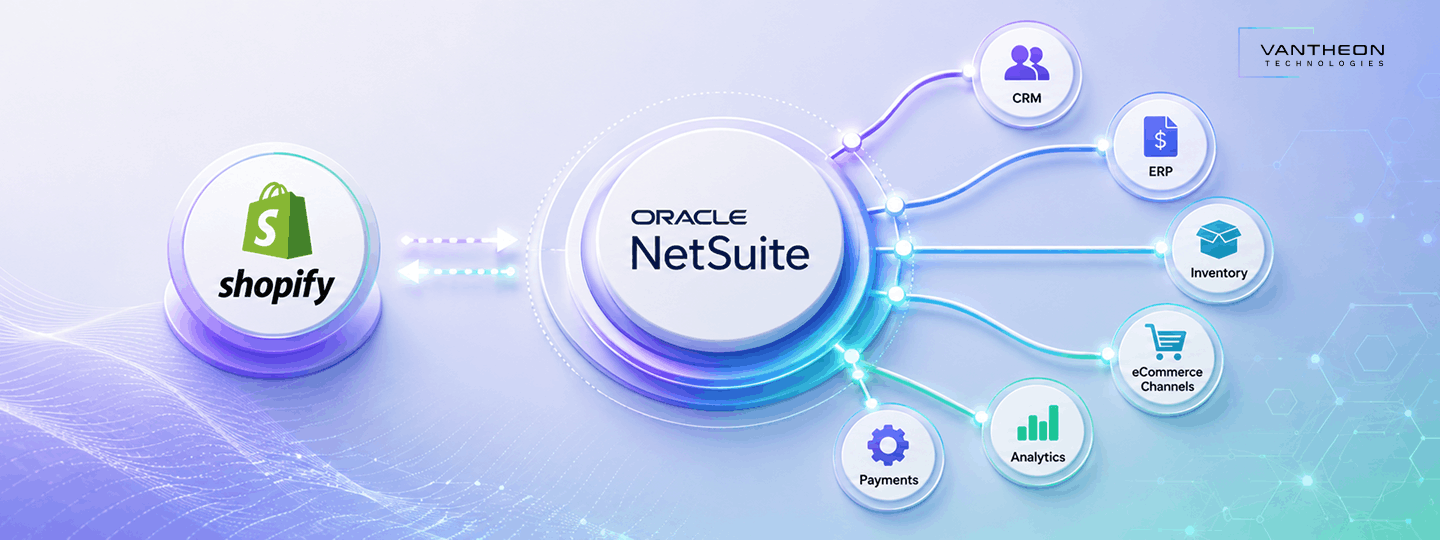
Running an online store on Shopify, Magento, or WooCommerce alongside Oracle NetSuite creates a common challenge. Orders come in on one platform, but inventory, financial records, and customer data need to live accurately in another. Without a proper connection between the two, finance teams end up re-entering data by hand, inventory counts drift out of sync, and reconciling payments becomes a monthly headache. This guide explains how NetSuite ecommerce integration actually works, from the underlying data flow to the technical methods available, and what UAE, KSA, and wider GCC businesses need to know before choosing an approach.
Why Integrate NetSuite with Your Ecommerce Platform?
Integrating NetSuite with an e-commerce platform connects the storefront where customers buy with the ERP system that manages inventory, finance, and fulfilment, so information moves automatically instead of requiring someone to copy it from one system to another. Without this connection, growing order volumes quickly outpace what a team can manually key in accurately, and errors in that manual process directly affect inventory accuracy and financial reporting.
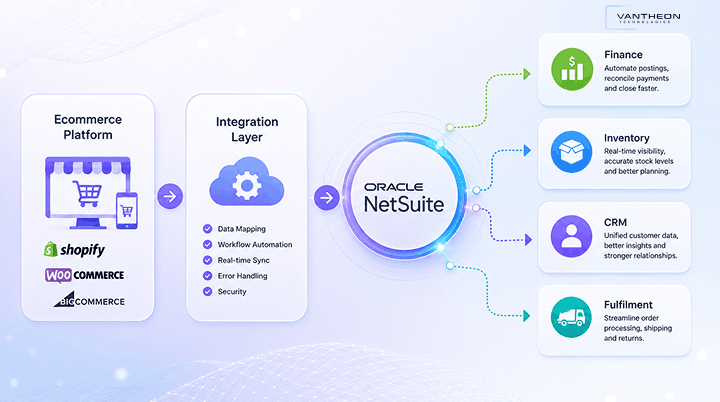
The real value is not simply linking two platforms together. It is establishing a consistent flow where an order placed on the storefront moves through an integration layer into NetSuite and updates finance, inventory, CRM, and fulfillment records as a coordinated process, rather than four separate manual tasks.
What Is NetSuite Shopify Integration?
NetSuite Shopify integration is the connection between a Shopify store and a NetSuite account that allows orders, customers, inventory levels, and payment data to move between the two systems automatically, using APIs, webhooks, or middleware, rather than manual data entry. This directly answers what NetSuite Shopify integration is: it is a data synchronization setup, not a single product, and it can be built using several different technical approaches depending on a business’s volume and complexity.
How Does NetSuite Ecommerce Integration Work?
NetSuite ecommerce integration works by mapping records between the two systems, so a Shopify order, customer, or product corresponds to a defined equivalent record in NetSuite, and then using an API, webhook, or middleware connection to keep those mapped records synchronized as activity happens on the storefront.
Data Mapping
Accurate integration depends on clear mapping rules between each system’s data structures. This is the foundation that determines how ecommerce ERP integration works in practice.
- Shopify SKU to NetSuite Item: Each product variant in Shopify needs to correspond to a specific item record in NetSuite, matched by SKU, so inventory and pricing stay aligned.
- Shopify Customer to NetSuite Customer: Customer records created or updated in Shopify are mapped to NetSuite customer entities, avoiding duplicate customer profiles across systems.
- Shopify Order to NetSuite Sales Order: A completed Shopify order becomes a sales order in NetSuite, carrying over line items, pricing, shipping details, and applicable taxes.
- Shopify Payment to NetSuite Payment or Financial Record: Payment captured on Shopify is reflected as a corresponding payment or deposit record in NetSuite, supporting accurate financial reconciliation.
- Shopify Fulfillment to NetSuite Fulfillment: Once an order ships, fulfillment status updates flow between systems so both the storefront and NetSuite reflect accurate shipping information.
What Data Should Be Synchronized Between Shopify and NetSuite?
The core data types that should synchronize between Shopify and NetSuite are product and inventory data, customer records, orders, payments, and fulfillment status, since these directly affect what a customer sees on the storefront and how finance and operations teams manage the business in NetSuite.
Beyond these core categories, many businesses also synchronize tax details, shipping rates, discount and promotion data, and return or refund records, depending on how much of the order lifecycle needs to be visible inside NetSuite for reporting and financial purposes.
Real-Time Inventory Sync Between ERP and Ecommerce
Real-time or near real-time inventory synchronization keeps stock levels shown on the storefront aligned with what NetSuite records as available, reducing the risk of overselling a product that is actually out of stock or understocking an item that has inventory sitting in NetSuite. It is worth being precise about the term real-time here.
Most integrations operate on a near real-time basis, where an inventory change in NetSuite triggers an update to Shopify within seconds to a few minutes, rather than instantaneously in every case. This distinction matters for setting realistic expectations. Businesses with fast-moving inventory across multiple channels should ask any integration provider exactly how quickly inventory changes propagate and what happens during a brief connectivity issue between systems.
Real-Time Order Processing Between Shopify and NetSuite
When a customer completes a purchase on Shopify, an integration can automatically create a corresponding sales order in NetSuite, triggering downstream processes like inventory allocation, fulfillment, and financial recording without a staff member manually re-entering the order. This is typically achieved through Shopify’s order webhook combined with a periodic reconciliation process that checks for any orders the webhook may have missed.
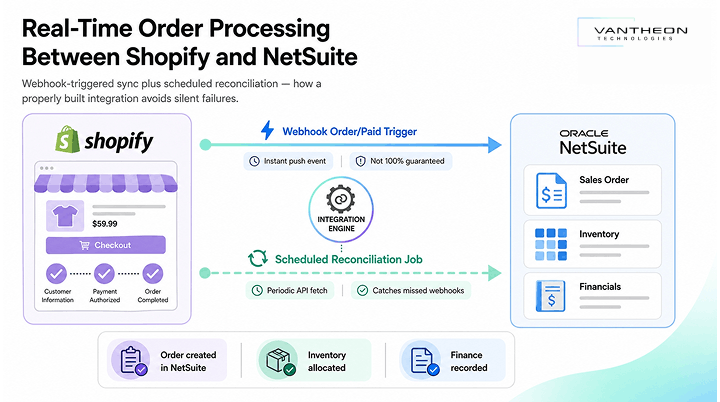
It is not accurate to claim every single Shopify transaction is guaranteed to become a NetSuite transaction automatically and instantly in every scenario. Shopify’s own developer documentation states plainly that webhook delivery is not always guaranteed, and recommends that applications receiving Shopify data implement periodic reconciliation jobs to fetch data directly from the API rather than relying on webhooks alone. A properly built NetSuite integration accounts for this by combining webhook-triggered updates with scheduled reconciliation checks, so a missed webhook does not silently result in an order that never reaches NetSuite.
How to Reflect Payments in NetSuite Immediately
Reflecting Shopify payments in NetSuite involves mapping the payment method and transaction details captured at checkout to a corresponding payment or cash deposit record in NetSuite, ideally tied to the same sales order the payment relates to. For most integrations, this happens shortly after the order is created, though the exact timing depends on how the payment gateway confirms the transaction and how the integration is configured to listen for that confirmation.
For UAE and KSA businesses processing payments in AED or SAR alongside other currencies for regional or international customers, correct currency mapping at this stage is essential, since a payment recorded against the wrong currency field can distort financial reconciliation later in the month.
Unified CRM and ERP Data Flow
A unified CRM and ERP data flow means customer information captured through ecommerce interactions, such as purchase history and contact details, feeds into NetSuite’s customer records, giving sales and support teams a single, consistent view of each customer rather than fragmented data spread across the storefront and the ERP separately.
This is particularly useful for businesses running both an online store and offline or wholesale channels through NetSuite, since it prevents the same customer from existing as two disconnected records depending on which channel they used.
NetSuite Integration With Magento and Adobe Commerce
NetSuite integrates with Magento and Adobe Commerce using a similar data mapping approach to Shopify, connecting products, customers, orders, and inventory, though the technical implementation differs because Magento and Adobe Commerce use a different API structure and typically involve more custom configuration for complex catalogs and multi-store setups.
Businesses running Magento or Adobe Commerce, especially those with B2B pricing rules or complex product configurations, often need more integration development work upfront compared to a standard Shopify connection, since Magento’s data model tends to be more customizable and therefore more variable from one implementation to another.
NetSuite Integration With WooCommerce
NetSuite can integrate with WooCommerce through middleware platforms or custom API-based connections, syncing orders, products, and customer data in a similar structure to Shopify and Magento integrations, though WooCommerce’s plugin-based architecture on WordPress means the specific technical approach often depends on which other plugins and extensions are already part of the store.
Because WooCommerce sites vary significantly based on the plugins a business has installed, a WooCommerce to NetSuite integration usually benefits from a discovery step to confirm exactly which data sources need to be connected before building the synchronization logic.
Shopify vs Magento vs WooCommerce for NetSuite Integration
These three platforms are not technically identical when it comes to NetSuite integration, and treating them as interchangeable leads to underestimating the work involved. Shopify offers the most standardized API and the most predictable integration path for businesses with relatively straightforward catalogs. Magento and Adobe Commerce offer greater flexibility and customization but generally require more integration development effort, particularly for complex B2B pricing or multi-store setups. WooCommerce sits closer to Shopify in API structure, but its integration complexity depends heavily on the specific plugin ecosystem a store has built up over time.
The right choice of ecommerce platform for NetSuite integration depends less on which one is universally “best” and more on which platform matches a business’s catalog complexity, existing technology stack, and growth plans.
RESTlet Integration in NetSuite
RESTlets are a NetSuite-specific method for building custom API endpoints inside NetSuite that external systems can call directly, giving developers precise control over exactly what data is exchanged and how it is processed. RESTlets are one option among several for NetSuite integration, not a universal requirement, and choosing the right method depends on the specific use case.
- SuiteTalk REST Web Services: Oracle’s standard REST-based API for NetSuite, offering broad access to standard records without requiring custom RESTlet development, generally a good starting point for straightforward integrations.
- RESTlets: Custom-built endpoints within NetSuite, useful when an integration needs specific business logic or a workflow that standard SuiteTalk calls do not directly support.
- SuiteTalk SOAP Web Services: NetSuite’s older SOAP-based API, still used in some existing integrations, though most new integration work today favors REST-based approaches.
- Webhooks: Event-driven notifications from the ecommerce platform, such as Shopify, that trigger an action when something happens, like a new order being placed, typically used alongside API calls rather than as a complete integration on their own.
- Middleware or iPaaS platforms: Third-party integration platforms that manage the connection between NetSuite and an ecommerce system, often reducing custom development time in exchange for a subscription cost and some limits on customization.
- Custom integration services: Purpose-built integration work combining several of the above methods, designed around a specific business’s exact workflow and data requirements.
This directly addresses what RESTlet integration in NetSuite is and what the SuiteTalk REST API is: RESTlets are custom and highly flexible, while SuiteTalk REST Web Services are Oracle’s standard, broadly capable API, and most real-world integrations use a combination of methods rather than relying on just one.
API and Webhook-Based NetSuite Ecommerce Integration
API-based integration involves NetSuite or the ecommerce platform actively requesting data from the other system on a schedule or on demand, while webhook-based integration involves the ecommerce platform pushing a notification to a listening endpoint the moment an event happens, such as an order being created. Most reliable ecommerce integrations use both approaches together.
Webhooks provide speed, since they trigger near-instantly when an event occurs, but as Shopify’s own documentation notes, webhook delivery is not always guaranteed, and applications should not depend on webhooks as the sole source of data. API-based polling or scheduled reconciliation jobs act as a safety net, periodically checking for any records that a webhook may have missed, which is the standard architecture recommended for production-grade ecommerce integrations rather than a webhook-only setup.
What Happens When an Integration Fails?
Integration failures happen for a range of reasons, and understanding the common failure points helps businesses evaluate whether a proposed integration approach has proper error handling built in, rather than assuming synchronization will always work perfectly.
- Failed API call: A request between systems times out or is rejected, and without retry logic, the associated data update simply does not happen.
- Duplicate order: A webhook fires more than once, or a reconciliation job overlaps with a webhook-triggered update, creating two records for the same transaction if the integration lacks duplicate detection.
- Inventory mismatch: A delay or failure in syncing stock levels results in the storefront showing availability that does not match what NetSuite actually has on hand.
- Missing webhook: An event notification never arrives due to a delivery issue, and without a reconciliation process, the related order or update never reaches NetSuite.
- Invalid SKU: A product listed on the storefront does not have a matching item record in NetSuite, causing the order creation step to fail.
- Customer mapping error: A customer record fails to match correctly between systems, resulting in a duplicate customer profile or an order attached to the wrong account.
- Payment mismatch: The payment amount or method recorded in NetSuite does not align with what was actually captured on the storefront, complicating reconciliation.
- Tax mapping error: Tax calculated at checkout does not correspond correctly to the tax codes or rates configured in NetSuite, which is a particular concern for UAE VAT and Saudi tax reporting accuracy.
- Currency mismatch: A transaction is recorded against the wrong currency field, distorting financial reports for businesses operating across AED, SAR, and other currencies.
A well-designed integration does not promise zero synchronization errors. It builds in monitoring, error logging, and reconciliation processes so that when something does go wrong, it is caught and corrected quickly rather than discovered weeks later during month-end close.
How NetSuite Ecommerce Integration Benefits UAE and KSA Businesses
NetSuite ecommerce integration gives UAE and KSA businesses a way to manage multi-channel sales, regional currencies, and multi-entity operations from a single connected system, reducing the manual reconciliation work that regional finance teams would otherwise face across separate ecommerce and ERP platforms.
UAE Use Cases
UAE businesses running ecommerce operations often manage multi-channel sales across their own storefront and regional marketplaces, process transactions in AED alongside other currencies for international customers, and operate across multiple free zone and mainland entities. A synchronized integration helps these businesses keep VAT reporting workflows fed with consistent transaction data, manage inventory across multiple warehouses accurately, reconcile payments faster, and maintain a unified view of regional customers across channels.
KSA Use Cases
Saudi Arabian businesses experiencing ecommerce growth similarly benefit from synchronized SAR transaction data, consistent multi-entity accounting across subsidiaries, and better inventory visibility across regional fulfillment centers. Faster payment reconciliation and more automated finance workflows reduce the manual burden on finance teams managing rising order volumes.
It is important to be clear that integration itself does not automatically ensure UAE VAT or Saudi ZATCA compliance. What it does is support data consistency, so tax-relevant transaction details flow accurately into NetSuite. Actual compliance still depends on how NetSuite’s tax setup, VAT and e-invoicing configuration, and broader ERP settings are configured to meet each country’s specific regulatory requirements.
Benefits of Integrating NetSuite With Ecommerce Systems
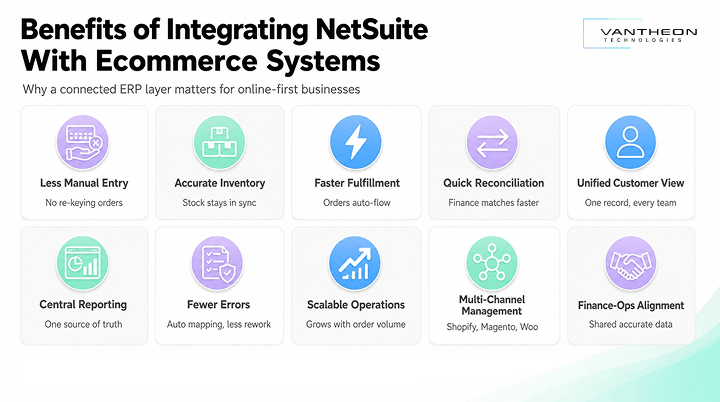
- Reduced Manual Data Entry: Staff no longer need to manually re-key orders, customers, or inventory updates between systems.
- Better Inventory Accuracy: Synchronized stock levels reduce the risk of overselling or understocking across channels.
- Faster Order Processing: Orders flow into NetSuite automatically, speeding up fulfillment timelines.
- Faster Financial Reconciliation: Payment and order data arriving consistently in NetSuite reduces the time finance teams spend matching transactions.
- Better Customer Visibility: A unified customer record gives sales, support, and finance teams the same view of each customer’s history.
- Centralized Reporting: Financial and operational reporting draws from a single, consistent data source rather than multiple disconnected platforms.
- Fewer Data Errors: Automated mapping reduces the human error that comes with manual data entry across systems.
- Scalable Ecommerce Operations: A properly built integration handles growing order volume without requiring proportionally more manual data handling.
- Better Multi-Channel Management: Businesses selling across Shopify, Magento, WooCommerce, or marketplaces can manage all channels through one connected ERP view.
- Improved Finance and Operations Collaboration: Shared, accurate data reduces the back-and-forth between finance and operations teams trying to reconcile conflicting numbers.
How to Choose the Right NetSuite Ecommerce Integration Approach
Choosing the right integration approach depends on order volume, catalog complexity, budget, and how much custom business logic the integration needs to support. Businesses with straightforward catalogs and standard workflows often do well with SuiteTalk REST Web Services combined with webhook-triggered updates and scheduled reconciliation. Businesses with more complex requirements, such as custom pricing logic, multi-entity order routing, or specific approval workflows, typically need RESTlets or custom integration development to handle logic that a standard API connection cannot.
Middleware or iPaaS platforms can reduce development time for businesses that want a faster setup and are comfortable with the platform’s built-in mapping capabilities, while custom integration services offer the most control for businesses with specific, non-standard requirements. The right answer is rarely a single universal method. It is usually a combination chosen to match the actual complexity of the business’s order and data flow.
How Vantheon Technologies Can Help
Vantheon Technologies designs and builds NetSuite ecommerce integrations for businesses across the UAE, KSA, and the wider GCC, covering Shopify integration, Magento and Adobe Commerce integration, and WooCommerce integration, using the API, RESTlet, SuiteTalk, or middleware approach that best fits each business’s actual order volume and complexity.
Our work covers the full integration lifecycle: inventory synchronization, order automation, payment integration, CRM-ERP integration, and the error handling and monitoring needed to catch issues like missed webhooks or mapping errors before they affect financial reporting. We also support ongoing NetSuite optimization and ongoing support after go-live, so integrations continue running reliably as order volume grows.
Looking to connect Shopify, Magento, or WooCommerce with NetSuite? Talk to Vantheon Technologies about designing an ecommerce integration that keeps orders, inventory, customers, and financial data synchronized.
Best Practices for NetSuite Ecommerce Integration
Businesses building or evaluating a NetSuite ecommerce integration should treat NetSuite as the single source of truth for inventory and financial data, so that when a discrepancy arises, there is a clear reference point for what the correct figure should be. Combining webhook-triggered updates with scheduled reconciliation jobs, rather than relying on webhooks alone, directly addresses the delivery gaps that Shopify and similar platforms acknowledge in their own documentation.
Setting up clear error monitoring and alerting means integration failures get caught within hours rather than being discovered during month-end close. Testing the integration thoroughly in a sandbox environment before going live, particularly around tax mapping and currency handling for regional transactions, helps avoid costly corrections after launch. Finally, planning for growth from the start, rather than building an integration that only handles current order volume, avoids the need for a costly rebuild once the business scales.
Conclusion
Integrating NetSuite with Shopify, Magento, WooCommerce, or any other ecommerce platform is not simply a matter of connecting two systems. It is about building a reliable data flow where orders, inventory, payments, and customer information move consistently from the storefront through an integration layer into NetSuite, keeping finance, inventory, CRM, and fulfillment aligned. For UAE, KSA, and GCC businesses managing multi-entity operations, multiple currencies, and growing order volumes, getting this integration architecture right, with proper reconciliation and error handling built in, makes the difference between an ERP system that reflects reality and one that constantly needs manual correction.
Ready to Connect Your Ecommerce Platform with NetSuite?
A reliable NetSuite ecommerce integration keeps your orders, inventory, customers, and financial data working together instead of living in separate systems. Vantheon Technologies helps businesses across the UAE, KSA, and the GCC design and build integrations that hold up as order volume grows.
Schedule a Demo with our NetSuite specialists to see how an ecommerce integration can fit into your operations.
Beyond ecommerce integration, Vantheon Technologies supports the full NetSuite lifecycle for businesses across the region, including:
- NetSuite Consulting to align your ecommerce and ERP strategy with your business processes
- NetSuite Implementation for organizations setting up NetSuite for the first time
- NetSuite Integration to connect NetSuite with your ecommerce platforms and other business systems
- NetSuite Customization to build custom RESTlets and workflows specific to your operations
- NetSuite Support Services for ongoing managed support and integration monitoring after go-live
- NetSuite Mobile ERP to keep your team connected to orders and inventory data wherever they are working
Whatever stage of your NetSuite ecommerce integration journey you are at, Vantheon Technologies is ready to help you move forward with confidence.
FAQ Section
What is NetSuite Shopify integration?
NetSuite Shopify integration is the connection between a Shopify store and NetSuite that synchronizes orders, customers, inventory, and payment data automatically, using methods like SuiteTalk REST Web Services, RESTlets, webhooks, or middleware, rather than manual data entry.
How does NetSuite sync inventory with Shopify in real time?
Inventory synchronization typically works on a near real-time basis, where a stock level change in NetSuite triggers an update to Shopify within seconds to a few minutes, using API calls combined with scheduled checks to catch any updates that a webhook may have missed.
Can Shopify orders and payments be automatically reflected in NetSuite?
Yes, when an integration is properly built, Shopify orders and payments can be automatically created as sales orders and payment records in NetSuite. Because Shopify’s own documentation notes that webhook delivery is not always guaranteed, reliable integrations also include periodic reconciliation jobs to catch any orders that a webhook missed.
Can NetSuite integrate with Magento and WooCommerce as well as Shopify?
Yes, NetSuite can integrate with Magento, Adobe Commerce, and WooCommerce using a similar data mapping approach to Shopify, though the technical implementation differs based on each platform’s API structure and, for WooCommerce, its plugin ecosystem.
What is the difference between RESTlets and SuiteTalk REST Web Services in NetSuite?
SuiteTalk REST Web Services is Oracle’s standard REST API, offering broad access to standard NetSuite records without custom development. RESTlets are custom-built endpoints within NetSuite that developers create when an integration needs specific business logic or a workflow not directly supported by standard API calls.
How can UAE and Saudi businesses benefit from NetSuite ecommerce integration?
UAE and Saudi businesses benefit through consistent multi-currency and multi-entity data flow, faster payment reconciliation, and better inventory visibility across warehouses and channels. Integration supports data consistency for VAT and tax-related reporting, though actual regulatory compliance still depends on how NetSuite’s tax and configuration settings are set up.