



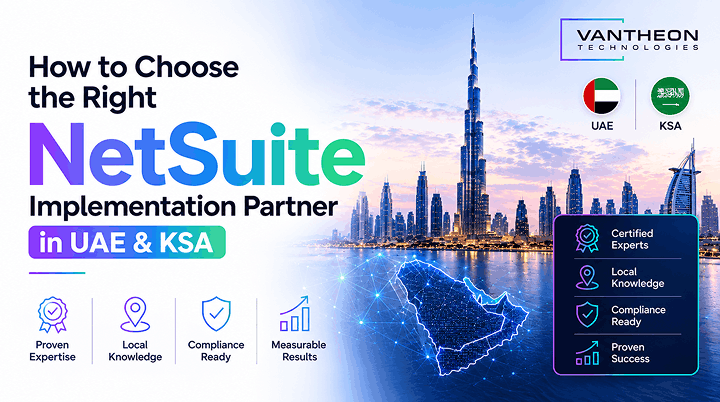
Choosing the right NetSuite implementation partner in the UAE or KSA is one of the most consequential decisions a growing business will make this year. The platform itself is proven. What determines whether you get a smooth go-live or a stalled, over-budget project almost always comes down to the partner sitting across the table from you.
This guide breaks down exactly what to look for in a NetSuite implementation partner in the UAE, KSA, or across the wider GCC. It covers certification checks, in-country ERP expertise, compliance requirements, red flags, the questions to ask before you sign, and a practical scorecard you can use to compare proposals side by side.
Why Choosing the Right NetSuite Implementation Partner Matters
A NetSuite implementation partner does far more than install software. They translate your finance, operations, and compliance requirements into a working system, migrate your historical data, connect NetSuite to the other tools your business relies on, and train your team to actually use it.
Get this decision right, and NetSuite becomes the operational backbone your business runs on for the next decade. Get it wrong, and you are looking at delayed go-lives, budget overruns, a system nobody trusts, and a second implementation project a year or two down the line to fix the first one.
The GCC’s cloud ERP market has grown quickly over the past few years, driven by Vision 2030 in Saudi Arabia and the UAE’s own digital transformation push. That growth has also brought a wider range of NetSuite partners into the market, from global consultancies to small regional resellers. Not all of them are equipped to handle UAE VAT and Corporate Tax, Saudi Arabia’s ZATCA e-invoicing mandate, or multi-entity GCC operations. This is why partner selection deserves the same rigor you would apply to choosing the ERP platform itself.
Working with an experienced NetSuite ERP consulting partner from day one helps you avoid the most common and most expensive implementation mistakes before they happen.
10 Criteria for Choosing a NetSuite Implementation Partner in UAE & KSA
Use the following ten criteria as your evaluation checklist. Together, they form a reliable set of ERP partner selection criteria that applies whether you are hiring a NetSuite implementation partner in the UAE, a NetSuite solution provider in KSA, or a partner to support a multi-country GCC rollout.
1. Verify NetSuite and Oracle Credentials
Start by confirming that the partner holds an active NetSuite Solution Provider agreement with Oracle. Ask how long the firm has held that status, how many NetSuite implementations it has completed, and whether it has real depth in your industry or company size. A firm that has spent years building a dedicated NetSuite practice with a full delivery team looks very different from one that added NetSuite as a side offering last year, even if both technically qualify as partners.
Firm level standing is only half the picture anyway. Ask which individual consultants will actually be staffed on your project and whether they hold current NetSuite certifications in the modules that matter to your business, such as Financials, SuiteCommerce, or Manufacturing. Push for a proposal that names real people instead of promising “resources to be assigned.” A firm can be well established and well regarded while the specific consultants on your account have limited hands on experience, so check both levels before you sign anything.
2. Evaluate Relevant Industry Experience
NetSuite behaves differently depending on the industry it is configured for. A partner who has implemented NetSuite extensively for trading and distribution companies will approach inventory, procurement, and multi-warehouse setup very differently from one whose background is in professional services or SaaS.
Ask for case studies or reference clients in your specific industry. Many partners use NetSuite’s Suite Success methodology, which offers pre-built, industry-specific configurations. A partner with real experience in your sector will be able to tell you, from experience, which parts of the standard configuration will fit your business as is and which will need adjustment.
3. Look for In-Country ERP Expertise
In-country ERP expertise is one of the most overlooked criteria and one of the most important. A partner with consultants physically based in the UAE or Saudi Arabia understands local business practices, works in your time zone, and can be on-site during critical phases like go-live and month-end close, when issues need to be resolved quickly.
In-country teams are also more likely to have hands-on experience with local banking formats, Arabic-language reporting requirements, and the specific compliance obligations covered in the next section. This is a meaningful differentiator between a NetSuite implementation partner in the UAE with genuine regional presence and an offshore team supporting the region remotely.
4. Check UAE and Saudi Compliance Expertise
Compliance is not optional, and it is not generic across the GCC. In the UAE, your NetSuite instance needs to correctly handle 5 percent VAT, UAE Corporate Tax at 9 percent above the AED 375,000 threshold, and the country’s upcoming e-invoicing mandate, which begins voluntarily from July 2026 and becomes mandatory from January 2027 for businesses with revenue above AED 50 million.
In Saudi Arabia, your partner needs practical experience with ZATCA’s Fatoora e-invoicing system, which is being rolled out in phased waves based on company turnover, along with Zakat and VAT reporting requirements. A partner without direct experience configuring NetSuite for these requirements will cost you time and rework later, often right when your business can least afford the disruption.
5. Assess the Partner’s NetSuite Implementation Methodology
Ask the partner to walk you through their exact implementation methodology, step by step. Most reputable partners follow a structured approach similar to NetSuite’s own Suite Success framework: discovery and scoping, configuration and build, data migration, testing, training, go-live, and a post-go-live hypercare period.
A partner who cannot clearly explain their methodology, or who gives you a vague answer like “we will figure it out as we go,” is a warning sign. A documented, repeatable methodology is what separates a predictable NetSuite implementation from one that drifts in scope and timeline.
6. Evaluate Data Migration and Integration Capabilities
Your historical financial, customer, and inventory data needs to move into NetSuite accurately and completely. Ask the partner about their data migration methodology, how they handle data cleansing, and how they validate that migrated data reconciles with your legacy system before go-live.
Just as important is their integration experience. Most businesses need NetSuite connected to e-commerce platforms, CRM systems, payroll, banking, or third-party logistics tools. Ask which integrations the partner has actually built before, not just which ones they claim to support. A partner offering strong NetSuite integration services should be able to name specific systems they have connected NetSuite to for other GCC clients.
7. Understand Their Customization Philosophy
NetSuite is highly configurable, and that flexibility can become a liability in the wrong hands. Ask the partner how they decide whether to customize the platform versus using standard, out-of-the-box functionality. The best partners default to configuration over custom code wherever possible, because heavy customization increases cost, extends timelines, and complicates future upgrades.
A partner offering thoughtful NetSuite customization services will be able to explain the trade-offs clearly and recommend the simplest solution that meets your business requirement, rather than defaulting to custom development for everything.
8. Compare Project Scope, Timeline and Pricing
Ask for a detailed, itemized proposal, not a single lump-sum number. A standard mid-market Suite Success implementation typically takes around three to five months, while complex, multi-entity, or multi-country implementations can run six to twelve months or longer. Pricing depends heavily on the number of subsidiaries, modules, integrations, data volume, and the level of customization involved.
Be cautious of any proposal that is significantly cheaper than the others you have received without a clear explanation of what has been reduced in scope. The cheapest proposal on paper is often the most expensive project once change orders start appearing.
9. Evaluate Post-Go-Live Support
Go-live is the beginning of your relationship with NetSuite, not the end of the project. Ask what support is included immediately after go-live, commonly referred to as hypercare, and what your ongoing support options look like once that initial period ends. Confirm response times, escalation paths, and whether support is delivered by consultants who actually understand your specific configuration.
A partner offering dedicated NetSuite support services with clear SLAs gives you confidence that issues will be resolved quickly, rather than sitting in a generic support queue.
10. Check Client References and Track Record
Before signing anything, ask for at least two or three client references, ideally in your industry and in the UAE or KSA specifically. Speak to these references directly and ask what went well, what did not, and whether the partner delivered on the original timeline and budget. A partner with a strong track record will offer references readily and without hesitation.
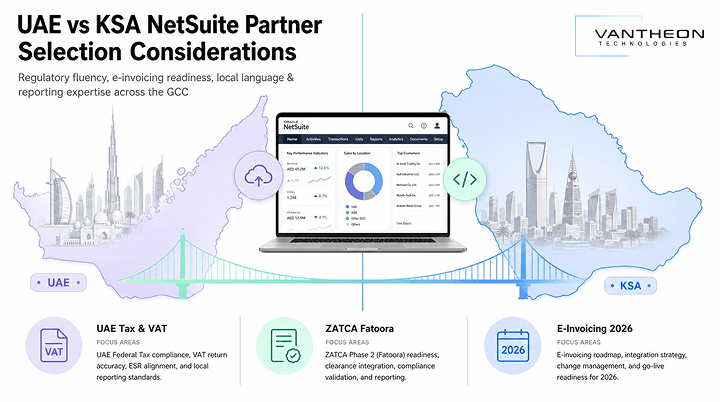
UAE vs KSA NetSuite Partner Selection Considerations
While the core evaluation criteria above apply everywhere, the UAE, KSA, and the wider GCC each carry their own regulatory and operational considerations that your partner needs to understand in practice, not just in theory.
Choosing a NetSuite Partner in UAE
A NetSuite implementation partner in the UAE needs to be fluent in the country’s evolving tax landscape. That means correctly configuring 5 percent VAT, UAE Corporate Tax obligations under Federal Decree-Law No. 47 of 2022, and preparing your system for the country’s phased e-invoicing rollout starting in 2026. Ask specifically how the partner plans to structure your NetSuite instance to stay compliant as the e-invoicing mandate moves from voluntary to mandatory.
Choosing a NetSuite Solution Provider in KSA
A NetSuite solution provider in KSA must have direct, hands-on experience with ZATCA’s Fatoora e-invoicing platform, including both the generation and integration phases of the mandate. Saudi Arabia’s e-invoicing waves are rolled out by taxpayer revenue threshold, so your partner should be able to tell you exactly which wave your business falls into and what technical integration is required to comply. Arabic-language reporting and Zakat considerations are additional factors that a genuinely local KSA partner will already be familiar with.
Choosing a NetSuite Partner for GCC Expansion
If your business operates or plans to operate across multiple GCC countries, look for a partner experienced in NetSuite’s OneWorld functionality for multi-subsidiary, multi-currency, and multi-language consolidation. The right partner will help you design a single NetSuite instance that supports centralized reporting while still meeting each country’s local compliance requirements individually, rather than forcing you into separate disconnected systems per country.
Questions to Ask a NetSuite Implementation Partner Before Signing
Use the following questions during your evaluation calls. A strong partner will answer each one directly and specifically, without vague or evasive responses.
-
- How many NetSuite implementations have you completed in the UAE and KSA?
-
- Do you have certified NetSuite consultants assigned to the project?
-
- Which industries do you specialize in?
-
- Who will actually manage our implementation?
-
- Do you have in-country consultants?
-
- How do you handle UAE VAT and Corporate Tax requirements?
-
- How do you handle ZATCA e-invoicing requirements?
-
- What is your data migration methodology?
-
- Which integrations have you implemented?
-
- How do you decide whether to customize NetSuite?
-
- What happens if the project goes over schedule?
-
- What post-go-live support is included?
-
- Can you provide relevant client references?
-
- What exactly is included and excluded from your proposal?
Red Flags When Choosing a NetSuite Implementation Partner
Watch for the following warning signs during your evaluation process. Any one of these should prompt closer questioning, and more than one is a strong signal to keep looking.
Red Flag 1: The Lowest Price Is the Main Selling Point
If a partner leads with price rather than approach, methodology, or experience, treat it as a warning sign. Implementations priced significantly below market rate usually mean reduced scope, junior consultants, or corners cut on testing and training, all of which surface as costly problems after go-live.
Red Flag 2: No Clear Project Scope
A vague or generic statement of work is one of the most common causes of implementation failure. If a partner cannot give you a detailed, itemized scope document before you sign, you have no reliable way to hold them accountable once the project starts.
Red Flag 3: Excessive Customization
Be cautious of a partner who recommends heavy customization from the very first conversation, before they have even fully understood your business processes. Excessive customization increases cost, slows down the project, and makes future NetSuite upgrades significantly harder.
Red Flag 4: No Local Compliance Knowledge
If a partner cannot clearly explain how they will configure your system for UAE VAT, UAE Corporate Tax, or Saudi Arabia’s ZATCA e-invoicing requirements, this is a serious gap. Compliance mistakes are expensive to fix retroactively and can expose your business to penalties.
Red Flag 5: No Named Implementation Team
If a partner cannot tell you exactly who will work on your project, by name, before you sign the contract, that is a red flag. Sales teams often oversell a firm’s capability while the actual delivery team is decided later, sometimes with far less relevant experience than the salesperson implied.
Red Flag 6: Weak Post-Go-Live Support
A partner who treats go-live as the finish line rather than the starting point is unlikely to be there when you need them most. Ask exactly what happens in the weeks immediately after go-live and beyond, and be wary of any partner who cannot describe a structured hypercare and ongoing support process.
How to Shortlist the Best NetSuite Implementation Partner
Bringing everything above together, a practical shortlisting process looks like this:
-
- Define your requirements first. Document your modules, subsidiaries, integrations, and compliance needs before you contact any partner.
-
- Verify credentials for both the firm and the named consultants who will work on your project.
-
- Request detailed proposals scored against the criteria and scorecard above, not just a price comparison.
-
- Check references directly, speaking to clients in your industry and region.
-
- Run a paid discovery or scoping workshop with your top choice before committing to the full implementation contract. This validates fit on both sides before the real work begins.
Why Businesses in the UAE and KSA Should Consider Vantheon Technologies
Vantheon Technologies works with businesses across the UAE, KSA, and the wider GCC to deliver NetSuite implementations built around local compliance, industry-specific configuration, and long-term system reliability. Our consultants bring in-country ERP expertise across finance, distribution, and services businesses, backed by hands-on experience configuring NetSuite for UAE VAT, UAE Corporate Tax, and ZATCA e-invoicing requirements in Saudi Arabia.
Rather than defaulting to heavy customization, our team follows a structured methodology that prioritizes clean configuration, accurate data migration, and integrations that actually hold up in production. We also provide dependable support after go-live, so your NetSuite investment continues to deliver value well beyond the initial rollout.
Planning a NetSuite implementation in the UAE, Dubai, KSA, or wider GCC? Speak with Vantheon Technologies to assess your ERP requirements and implementation roadmap.
Beyond implementation, Vantheon supports your NetSuite journey end-to-end. Our services include NetSuite ERP consulting to shape your roadmap, NetSuite integration services to connect NetSuite with the tools your business already relies on, NetSuite customization services for the specific workflows that need it, and ongoing NetSuite support services to keep your system running smoothly after go-live. We also help businesses extend NetSuite further with NetSuite automation solutions and AI-powered finance automation, and with NetSuite Mobile ERP for teams that need real-time visibility on the move.
Schedule a demo with Vantheon Technologies to start planning your NetSuite implementation in the UAE, KSA, or across the GCC.
Frequently Asked Questions
1. How do I choose a NetSuite implementation partner in the UAE?
Evaluate the partner’s NetSuite and Oracle credentials, industry experience, in-country presence, and knowledge of UAE VAT and Corporate Tax requirements. Compare their implementation methodology and post-go-live support model, then confirm everything with direct client references before signing.
2. What should I look for in certified NetSuite consultants in Dubai?
Look beyond firm-level certification and confirm which individual consultants will actually work on your project, and whether they hold current NetSuite certifications relevant to your modules and industry. Ask for their track record on similar implementations in the UAE.
3. How much does a NetSuite implementation partner cost in Dubai or KSA?
Cost depends on the number of subsidiaries, modules, integrations, data volume, and the level of customization your business needs. Rather than comparing a single number, request an itemized proposal so you understand exactly what drives the price and can compare partners fairly.
4. Why is in-country ERP expertise important for UAE and KSA businesses?
In-country consultants understand local compliance requirements, work in your time zone, and can provide faster on-site support during critical phases like go-live. This reduces the risk of miscommunication and delays compared to working with an entirely offshore team.
5. What makes a good NetSuite solution provider in KSA?
A good NetSuite solution provider in KSA has direct experience with ZATCA e-invoicing integration, understands Zakat and VAT reporting requirements, and can support Arabic-language reporting needs. Local presence and a documented track record of successful Saudi go-lives are strong indicators of capability.
6. Should I choose a local NetSuite partner or a global consultancy?
This depends on your priorities. Global consultancies often bring broader bench strength and cross-industry experience, while regionally embedded partners typically offer deeper knowledge of UAE and KSA compliance and faster local support. Many GCC businesses choose a regional partner that also holds strong, verified NetSuite certification, combining local expertise with proven platform capability.