


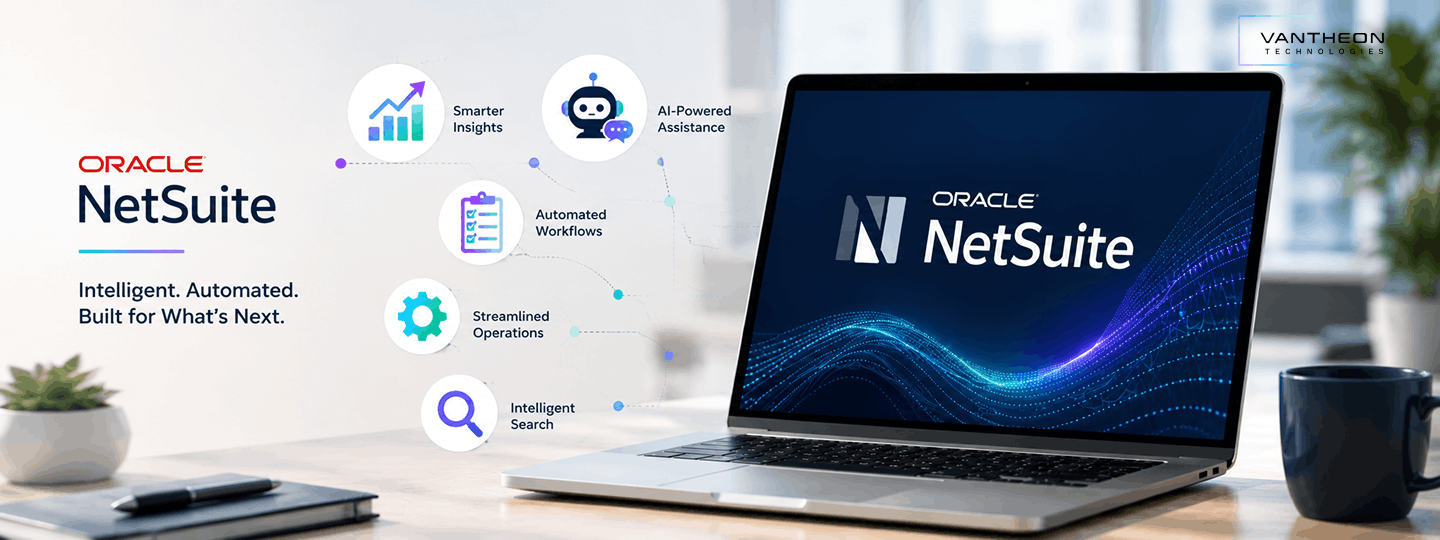
Oracle has started rolling out NetSuite Next, described by NetSuite founder Evan Goldberg as one of the most significant platform announcements in the product’s history. Built entirely around artificial intelligence, NetSuite Next moves AI out of the sidebar and into the core of the ERP experience. For finance leaders, IT managers, and business owners across the UAE and Saudi Arabia, this rollout is not a minor feature drop. It changes how teams query data, close their books, plan scenarios, and run daily operations inside NetSuite.
This guide breaks down what NetSuite Next actually includes, what Ask Oracle does, how the new AI capabilities work, and what UAE and KSA businesses should do to prepare. It also outlines how Vantheon Technologies helps organizations across the region get the most value out of this release.
NetSuite Next Has Arrived, Why It Matters
NetSuite Next is not a bolt-on module or a separate licensed add-in. It is a re-architecture of the platform itself, with AI embedded across search, reporting, dashboards, workflow automation, and customer-facing processes. Oracle introduced the concept at SuiteWorld 2025 and has continued expanding it through subsequent release cycles, with the rollout now extending to customers in phases.
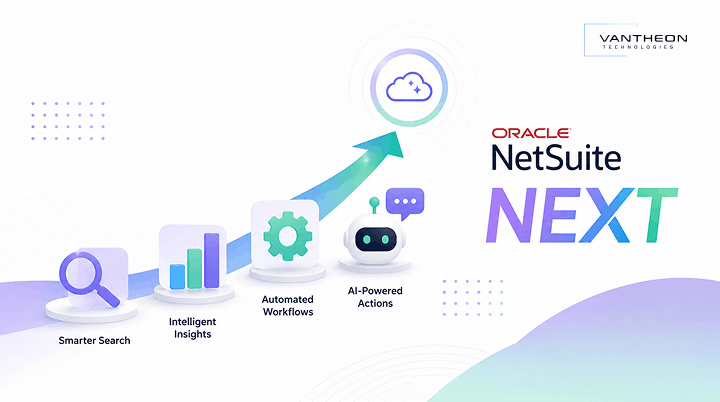
For businesses running NetSuite in the UAE and Saudi Arabia, three things make this release different from previous updates.
First, activation does not require a system migration. NetSuite Next is enabled within an existing account, and customizations, SuiteApps, and integrations are designed to carry forward. Second, the AI capabilities are included in existing NetSuite licenses, so organizations are not being asked to buy a separate AI product. Third, the platform’s new interface, built on Oracle’s Redwood Design System, changes how every screen looks and behaves, which has a direct impact on daily user productivity.
For a region where finance teams manage multi-entity structures, VAT reporting in the UAE, ZATCA e-invoicing compliance in Saudi Arabia, and bilingual Arabic and English operations, an ERP that can answer questions in plain language and act on data automatically is a meaningful operational shift, not just a UI refresh.
What Is Ask Oracle?
Ask Oracle is the natural language AI assistant built into NetSuite Next. It sits across the platform rather than in a single module, which means a user can ask a business question in plain English (or in some cases, other supported languages) instead of building a saved search, navigating through multiple reports, or waiting on an admin to pull a number.
A finance manager might type, “What is our outstanding receivables balance by subsidiary this month?” A warehouse supervisor might ask, “Which SKUs are below the reorder point?” Ask Oracle interprets the request, retrieves data from the relevant records, and returns an answer as a chart, table, or narrative summary, whichever format communicates the answer most clearly.
One of the more practical aspects of Ask Oracle AI assistant features is that responses are role-aware. A CFO and a warehouse coordinator can ask a similar question and receive answers scoped to their own permissions and context. Nobody sees data outside what their NetSuite role already allows, which matters for organizations with strict internal controls and segregation of duties, a common requirement for regulated entities and public sector-adjacent businesses in the GCC.
Ask Oracle also retains context across a conversation. A user can ask a follow-up question without restating the entire query, similar to a natural back-and-forth conversation with a colleague who already understands the business.
New AI Capabilities Added to NetSuite
Beyond Ask Oracle, NetSuite Next introduces a set of AI capabilities that touch nearly every part of daily ERP work. Below is a breakdown of what each capability does and why it matters for operational teams.
AI-Powered Search
Search inside NetSuite Next moves beyond exact keyword matching. Users can search using natural, conversational phrasing, and the system understands intent, surfacing the right transactions, records, or reports even when the exact terminology used does not match the field names in the database. This reduces the time employees spend hunting through menus or asking IT for help locating a report.
Conversational Business Insights
Instead of exporting data to a spreadsheet for analysis, users can ask Ask Oracle direct business questions and receive an immediate, contextual answer. This is particularly useful for executives who want quick visibility into performance without waiting for a formal report to be built and circulated.
Financial Reporting Assistance
AI-assisted reporting helps finance teams generate summaries, identify variances, and draft narrative commentary around financial results. For UAE and KSA finance departments managing multi-entity consolidations across free zone and mainland structures, this reduces the manual effort involved in preparing management reports each month.
AI-Powered Dashboards
Dashboards in NetSuite Next can be populated and adjusted using natural language requests, and they surface relevant metrics based on a user’s role automatically. Rather than manually configuring every KPI tile, users can describe what they want to see and the dashboard adapts.
Intelligent Recommendations
The platform surfaces recommendations based on patterns in historical data, such as suggested reorder quantities, likely vendor selections, or anomalies worth reviewing before they become larger issues. These recommendations sit inside existing workflows rather than requiring a separate analytics tool.
Automated Content Generation
NetSuite Next can help generate written content directly inside the platform, including item descriptions, customer communications, and internal notes, saving time for teams that previously drafted this content manually for every record.
Workflow Automation
Where traditional NetSuite automation relies on predefined rules through SuiteFlow, NetSuite Next introduces agentic workflows that go a step further. These AI-driven workflows can analyse a situation, determine an appropriate next step within configured boundaries, and carry out that action, with or without a human approval step depending on how the workflow is configured. Examples include automated reconciliation matching during financial close, vendor payment batch proposals based on due dates and cash position, and purchase order suggestions triggered by inventory thresholds.
Predictive Analytics
Built-in predictive capabilities help forecast demand, cash flow, and other operational metrics using historical transaction data, giving finance and operations teams an earlier signal on trends before they fully materialize in the numbers.
AI for Customer Service
Customer service teams benefit from AI-assisted case handling, including suggested responses and faster access to a customer’s full account history, order status, and prior interactions, all surfaced without navigating multiple records.
AI for Procurement
Procurement teams gain AI support for vendor evaluation, purchase order generation, and exception handling, reducing the manual review required for routine purchasing decisions while keeping approval controls intact.
How NetSuite AI Benefits UAE and Saudi Arabian Businesses
Businesses across the UAE and Saudi Arabia operate in an environment shaped by rapid digital transformation mandates, strict tax compliance requirements, and a growing expectation of real-time decision-making. NetSuite AI features are particularly relevant to this environment for a few reasons.
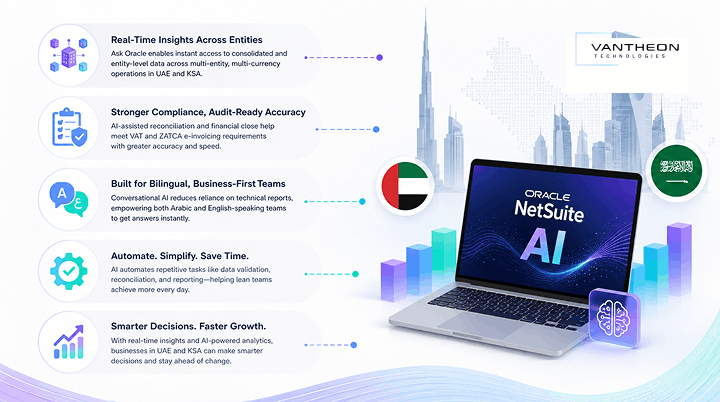
Multi-entity and multi-currency operations are common across the region, with holding structures spanning UAE mainland, free zones, and KSA operating entities. Ask Oracle allows finance leaders to query consolidated and entity-level data instantly, without waiting for a manually built report.
VAT compliance in the UAE and ZATCA e-invoicing requirements in Saudi Arabia demand accuracy and speed in financial reporting. AI-assisted reconciliation and financial close capabilities reduce the manual effort involved in getting numbers audit-ready each period.
Bilingual operations are standard across the GCC, and a conversational assistant that reduces dependency on technical report-building helps non-technical staff, including Arabic-speaking teams, get answers without relying on an ERP specialist for every query.
Labor markets across the UAE and KSA are competitive, and organizations are under pressure to do more with lean finance and operations teams. AI-powered ERP for UAE businesses reduces the administrative load on existing staff by automating repetitive tasks such as data entry validation, reconciliation matching, and routine reporting.
Key Features of the NetSuite Next Release
Summarizing the release, the core components UAE and KSA businesses should be aware of include:
- Ask Oracle, the natural language assistant available across the platform.
- Agentic workflows that combine analysis with automated action
- AI-powered dashboards and reporting that adapt to user roles
- Predictive analytics for demand, cash flow, and operational forecasting
- Automated financial close support, including AI-assisted transaction matching
- The Redwood Design System, a redesigned interface available as an opt-in toggle
- No additional licensing cost for existing NetSuite customers
- No forced migration, with existing customizations and integrations designed to carry over
AI-Powered ERP vs Traditional ERP
| Capability | Traditional ERP | AI-Powered ERP (NetSuite Next) |
| Data access | Saved searches and pre-built reports | Plain language queries through Ask Oracle |
| Automation | Rule-based triggers only | Agentic workflows that analyse and act |
| Reporting | Manual report building | AI-assisted summaries and dashboards |
| Forecasting | Manual spreadsheet modelling | Built-in predictive analytics |
| Financial close | Manual reconciliation | AI-assisted matching and close agents |
| User dependency | Requires admin or technical skill | Accessible to non-technical users |
The practical difference is that a traditional ERP puts the burden of interpretation on the user, while an AI-powered ERP for UAE businesses shares that burden with the system itself, surfacing insights and even taking configured actions before a person has to ask.
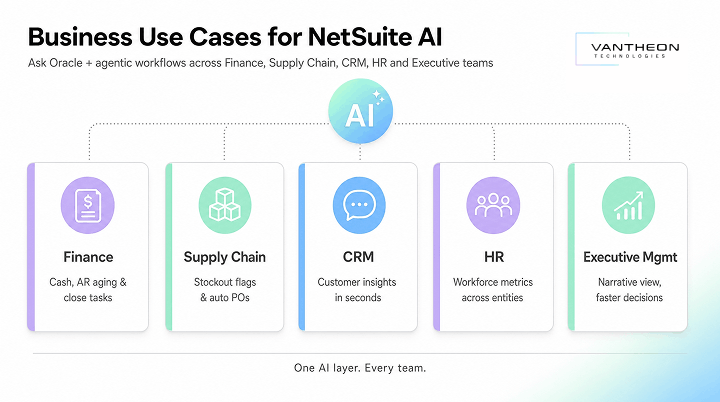
Business Use Cases for NetSuite AI
Finance
Finance teams use Ask Oracle to query cash position, receivables aging, and subsidiary-level performance instantly, while agentic workflows assist with reconciliation and close tasks that previously consumed days of manual effort each month.
Supply Chain
Supply chain teams rely on AI-powered dashboards and predictive analytics to track inventory levels, flag SKUs approaching stockouts, and automate purchase order generation based on configured thresholds.
CRM
Sales and account management teams use conversational insights to pull up customer history, order patterns, and account health in seconds, reducing the time spent preparing for client conversations.
HR
HR and people teams benefit from AI-assisted reporting on workforce metrics, helping regional HR leaders track headcount, turnover, and compliance-related data across multiple entities without manual data consolidation.
Executive Management
Executives use Ask Oracle to get a fast, narrative view of business performance without waiting for a formal board report, supporting faster strategic decisions.
Preparing for the NetSuite Next Rollout
Activating NetSuite Next is a straightforward toggle within an existing account, but getting real value from it depends on preparation. Organizations in the UAE and KSA should focus on the following before their rollout phase activates.
Start with a data quality review. Ask Oracle’s answers are only as reliable as the underlying data, so cleaning up duplicate customer records, inconsistent item naming, and unmapped fields will directly improve the accuracy of AI-generated responses.
Review roles and permissions carefully. Since Ask Oracle is role-aware, it is worth confirming that every role reflects the correct level of data access before rollout, particularly for organizations with segregated finance and operations teams.
Audit existing customizations. SuiteScript and SuiteFlow automations built over the years should be documented, both to confirm compatibility and to identify which ones are strong candidates for conversion into agentic workflows.
Test in a sandbox environment first. Running the NetSuite Next activation in a non-production account allows IT teams to confirm that integrations, customizations, and third-party connectors behave as expected before go-live.
Plan for user training. The biggest barrier to adoption is habit. Employees accustomed to building saved searches need a short training push and a clear point of contact to encourage them to use Ask Oracle and the new AI tools from day one.
How Vantheon Technologies Helps Businesses Maximize NetSuite AI
Vantheon Technologies works with organizations across the UAE and Saudi Arabia to implement, customize, and support Oracle NetSuite, and that includes helping businesses prepare for and adopt NetSuite Next.
Our team supports the full journey: data readiness assessments before activation, role and permission audits, sandbox testing of existing customizations, and structured training programs that help finance, operations, and customer-facing teams start using Ask Oracle and the new AI capabilities productively from the first day of rollout.
Because we work directly with regional compliance requirements, including UAE VAT and Saudi ZATCA e-invoicing, we help businesses configure NetSuite Next in a way that keeps financial reporting accurate and audit-ready while taking advantage of the new automation and reporting capabilities.
Whether your organization needs a fresh Oracle NetSuite Implementation Services, ongoing NetSuite ERP Consulting, or help preparing an existing NetSuite environment for this rollout through our NetSuite Support & Managed Services, Vantheon Technologies is positioned to guide your NetSuite Next adoption from planning through to full utilization.
Best Practices for Adopting AI-Powered ERP
Businesses that get the most value from AI-powered ERP software UAE-wide tend to follow a similar pattern. They treat AI adoption as a change management exercise, not just a technical toggle, and they invest time in training before expecting teams to rely on the new tools.
They also start with a small number of high-impact use cases, such as financial close automation or inventory reorder alerts, rather than trying to transform every process at once. This allows teams to build trust in the AI outputs before expanding usage further.
Data governance should be treated as an ongoing discipline rather than a one-time cleanup, since AI accuracy depends on consistently maintained records. Finally, businesses should keep human review in place for AI-suggested actions in their early months of use, gradually reducing manual approval steps as confidence in the system’s recommendations grows.
Conclusion
The NetSuite Next rollout, anchored by Ask Oracle and a wide set of new AI capabilities, represents a real shift in how ERP systems support daily decision-making. For businesses in the UAE and Saudi Arabia balancing regional compliance demands, multi-entity structures, and lean operating teams, this release offers a practical way to reduce manual work and get faster answers from existing NetSuite data, without a system migration or additional licensing cost.
Getting there smoothly still requires preparation: clean data, reviewed permissions, tested customizations, and a team that knows how to use the new tools. That is where an experienced regional implementation partner makes the difference between a rollout that sits unused and one that changes how your business operates day to day.
Ready to Bring NetSuite Next to Your Business?
NetSuite Next is a major step forward, but getting real value from Ask Oracle and the new AI capabilities depends on how well your NetSuite environment is prepared. Vantheon Technologies helps businesses across the UAE and Saudi Arabia get ready for this rollout and put it to work from day one.
Schedule a Demo with our NetSuite specialists to see how NetSuite Next can fit into your operations.
Beyond NetSuite Next readiness, Vantheon Technologies supports the full NetSuite lifecycle for businesses across the region, including:
- NetSuite Consulting to align NetSuite with your business processes and compliance needs
- NetSuite Implementation for organizations moving to NetSuite for the first time
- NetSuite Integration to connect NetSuite with your existing systems and third-party applications
- NetSuite Customization to tailor workflows, forms, and automation to your specific operations
- NetSuite Support Services for ongoing managed support after go-live
- NetSuite Mobile ERP to keep your team connected to NetSuite data on the move
Whatever stage of your NetSuite journey you are at, Vantheon Technologies is ready to help you move forward with confidence.
Frequently Asked Questions
What is NetSuite Next, and how is it different from previous NetSuite releases?
NetSuite Next is Oracle’s re-architecture of the NetSuite platform with AI built into its core rather than added as a separate module. Unlike previous updates that introduced individual features, NetSuite Next changes how users interact with data across the entire platform through Ask Oracle, agentic workflows, and a redesigned Redwood interface, all included within existing licenses.
What is Ask Oracle, and how does the AI assistant work within NetSuite?
Ask Oracle is a natural language assistant embedded across NetSuite that lets users ask business questions in plain language and receive answers as charts, tables, or summaries. It is role-aware, so responses are scoped to each user’s existing permissions, and it retains context across a conversation so users can ask follow-up questions naturally.
What new AI features are available in Oracle NetSuite?
New AI features include Ask Oracle for conversational data access, agentic workflows for automated analysis and action, AI-powered dashboards and search, predictive analytics, automated content generation, and AI-assisted financial close and reconciliation, all delivered inside the Redwood interface.
How can AI-powered ERP improve business operations in the UAE and Saudi Arabia?
AI-powered ERP helps regional businesses manage multi-entity and multi-currency operations more efficiently, speeds up VAT and ZATCA-related financial reporting, reduces reliance on technical staff for routine data queries, and automates repetitive finance and supply chain tasks, allowing lean teams to operate at a higher capacity.
Is NetSuite Next suitable for small and mid-sized businesses, or only large enterprises?
NetSuite Next is included within existing NetSuite licenses at no additional cost, which makes it accessible to small and mid-sized businesses as well as larger enterprises. Smaller teams in particular benefit from AI-assisted reporting and automation since it reduces the need for dedicated technical resources to build reports or manage manual reconciliation.
How can Vantheon Technologies help businesses adopt NetSuite Next and its AI capabilities?
Vantheon Technologies supports UAE and KSA businesses through data readiness assessments, role and permission audits, sandbox testing of existing customizations, and structured training so teams can start using Ask Oracle and the broader NetSuite Next AI capabilities effectively from day one of the rollout.