



Three acronyms. One mandate. Let’s go.
If you’ve spent the last few weeks Googling “UAE e-invoicing” and ended up with seventeen tabs open, none of them quite answering your question, then this article is for you.
You don’t need to become an expert. You need a working mental model. Something you can carry into a Monday morning meeting with your IT head, your auditor, and your CFO without bluffing.
So, we’re going to build that mental model in three layers: what Peppol actually is, what an ASP actually does, and how the 5-corner model holds it all together. Plus, the UAE-specific bit at the end that most international explainers leave out.
No jargon for jargon’s sake. No vendor pitches. Just the model.
Part 1: What is Peppol, really?
Peppol is not software. Peppol is not a company. Peppol is not a tax rule.
Peppol is a set of agreements.
Specifically, it’s a set of agreed standards and a governance body — OpenPeppol — that lets different countries, different software systems, and different ASPs send structured business documents (invoices, credit notes, orders) to each other reliably and securely. Think of it as the email protocol of business documents with built-in identity, integrity, and routing.
It was born in Europe in 2008 to solve a very practical problem: a Norwegian supplier shouldn’t need a custom integration with every Dutch tax authority to send an invoice. That’s wasteful. So Peppol said: agree on the file format, agree on the routing rules, agree on the identifiers, and let any compliant access point talk to any other.
Today, Peppol is used in 40+ countries. The UAE has adopted it as the backbone of its e-invoicing model. So do Belgium, Singapore, Australia, New Zealand, Japan, and Malaysia.
When you hear “Peppol”, you should think:
- A standard file format (UBL XML — the universal business language)
- A standard identification system (every business gets a Peppol ID)
- A standard delivery network (access points talk to access points)
- A standard governance model (OpenPeppol sets the rules, national authorities enforce them locally)
That’s it. Peppol is the rulebook. Now we need to talk about who plays.
Part 2: What is an ASP, really?
ASP stands for Accredited Service Provider. In the UAE context, it means: a company that has been formally accredited by the FTA to operate as a Peppol Access Point inside the UAE’s e-invoicing model.
That’s the formal definition. Now the useful one.
An ASP is the bridge between your finance system and the rest of the world.
When your ERP — SAP, Oracle, Dynamics, Tally, Zoho, whatever you use — produces an invoice; it produces it in your format. Maybe a PDF. Maybe an Excel. Maybe an XML in your ERP’s own dialect.
That’s not enough. The FTA needs a specific structured format (PINT AE, the UAE’s Peppol invoice specification). Your customer’s ERP probably doesn’t speak in that format either. And somebody has to make sure the invoice actually reaches the right place, in the right format, signed and validated, with a clean audit trail.
That’s the ASP’s job. Three things, really:
- Translate: Take your ERP’s output and convert it into the Peppol-compliant PINT AE format the FTA expects.
- Transmit: Sign it, secure it, route it through the Peppol network to your customer’s ASP (and to the FTA).
- Track: Keep proof of delivery, status, errors, and corrections — so when the audit comes, you have receipts.
A good ASP makes those three jobs invisible. You shouldn’t feel them. Your finance team shouldn’t change how they work. The ASP sits between your ERP and the network, and the right invoices reach the right places.
That’s why “which ASP” matters more than most CFOs realize. The wrong ASP makes those three jobs visible — broken integrations, failed transmissions, late corrections, support tickets, audit anxiety.
The right ASP, you forget it is even there.
Part 3: The 5-Corner Model (this is where most explainers lose people)
You may have heard of the 4-corner model. That was Peppol’s original architecture: supplier, supplier’s access point, buyer’s access point.
Four corners.
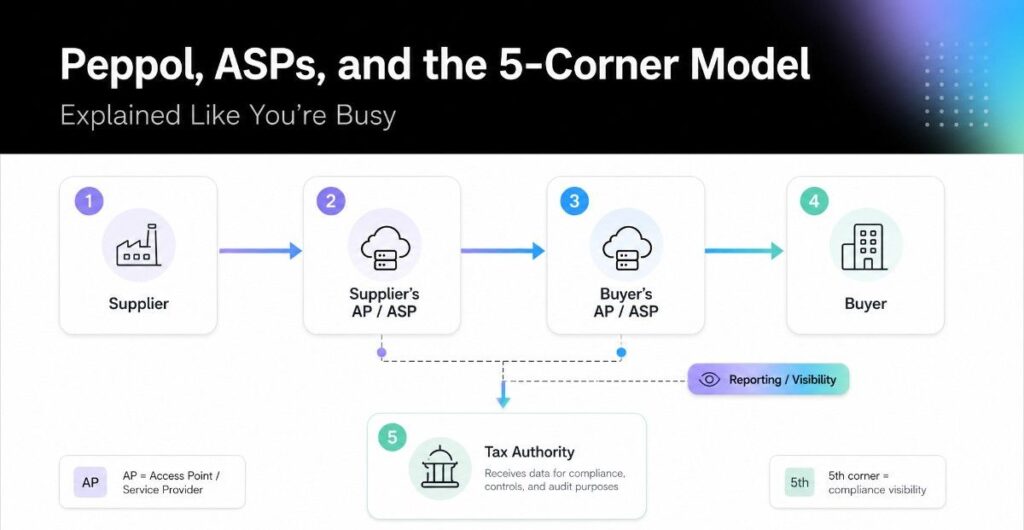
The UAE, like Malaysia and a growing list of others uses a 5-corner model. The fifth corner is the tax authority. In our case, the FTA.
Here’s what that looks like in practice. Imagine a courier service:
- Corner 1: The supplier (you). You generate the invoice in your ERP.
- Corner 2: Your ASP. Picks up the invoice, translates it into PINT AE, and signs it.
- Corner 3: Your buyer’s ASP. Receives the invoice over the Peppol network, validates it.
- Corner 4: The buyer. Receives the invoice, posts it into their own ERP.
- Corner 5: The FTA. Receives a copy of the invoice metadata in near-real-time, for tax visibility, audit, and compliance.
Notice what changed. In the 4-corner model, the tax authority sees invoices later, in returns. In the 5-corner model, the tax authority sees the invoice as it happens.
That single shift from “report later” to “report as you go” is the entire substance of e-invoicing. Every implementation detail flows from it.
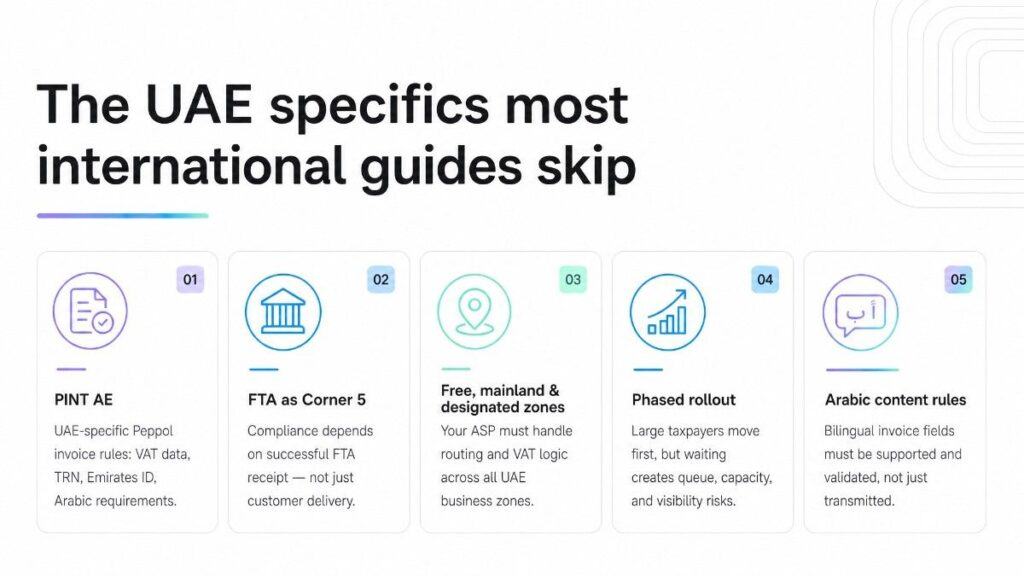
Part 4: The UAE specifics most international guides skip
Here’s what makes the UAE flavor different from generic Peppol:
1. PINT AE — the UAE’s Peppol invoice specification
PINT (Peppol International Invoice) is the international base. PINT AE is a UAE-specific extension. Additional fields for VAT-specific data, Emirates ID and TRN (Tax Registration Number) handling, Arabic content where required, and rules unique to UAE commerce. If your ASP can’t produce a valid PINT AE invoice, it can’t serve UAE businesses. Full stop.
2. The FTA as Corner 5 — and what that means operationally
The FTA being a corner means your invoice flow now has a third party who must successfully receive your data, every time. If transmission to the FTA fails, the invoice is not compliant — even if it reaches your customer. This is the part most companies underestimate. The reliability of corner 5 is non-negotiable, and choosing an ASP without rock-solid FTA-side telemetry is asking for audit headaches.
3. Free zones, mainland, designated zones — the model handles them all
UAE’s e-invoicing scope covers mainland, free zone, and designated zone businesses, subject to VAT registration and the rollout phasing. Your ASP needs to handle the routing logic for each — including the specific rules around supplies to and from designated zones, which behave differently for VAT purposes.
4. Phased rollout and why these matters for your timeline
The UAE rollout is phased by business size and by sector. The earliest mandatory phases will catch large taxpayers; smaller businesses follow. But here’s the operational truth: you do not want to be in the late phase. The late-phase businesses will be onboarded into a network with fewer free ASP slots, longer integration queues, and a public-facing FTA list where the first names already dominate the search results.
5. Arabic content rules
PINT AE allows for bilingual content (Arabic + English). Your ERP outputs may not natively support Arabic content for all invoice fields. Your ASP should not just transmit — it should validate that the bilingual rules are satisfied, especially in customer-facing fields.
Part 5: Where Vantheon sits in this picture
Vantheon is an ASP. Specifically, what that means for you, practically:
- We are in corner 2 of your flow. We pick up your invoices from your ERP, and we translate, sign, transmit, and track.
- We transmit your invoice to Corner 3 (Your Customer’s ASP) to eventually deliver the invoice to your Customer (Corner 4).
- We give you visibility into corner 5. Every invoice has a tracked status with the FTA: received, validated, accepted, or flagged for correction.
- We don’t replace your ERP. We don’t ask you to change how your finance team works. We sit between your ERP and the network.
- We are built for the UAE’s specifics PINT AE, bilingual content, free zone routing, designated zone rules not as an afterthought, but as the core.
That’s the product. The longer “How to choose an ASP?” This question gets its own blog. Read it here. It’s a question that deserves more than a paragraph.
Part 6: A 60-second recap
Read this aloud if you ever need to explain UAE e-invoicing to your board in a single breath:
THE 60-SECOND VERSION
“The UAE has adopted the Peppol network for e-invoicing. Peppol is a set of standards — file format, identifiers, routing — that lets different systems talk to each other.
You connect to the Peppol network through an ASP — an Accredited Service Provider, approved by the FTA. The ASP translates your ERP’s output into the UAE’s required format (PINT AE), signs it, transmits it to your customer’s ASP, and sends a copy to the FTA in near-real-time.
That’s the 5-corner model: you, your ASP, your customer’s ASP, your customer, and the FTA.
You don’t change your ERP. You change your plumbing.”
Simplify Your Peppol and E-Invoicing Setup with Vantheon Technologies
For finance and IT teams in the UAE gearing up for mandatory e-invoicing, terms like Peppol, ASPs, and the 5-corner model can quickly turn into a lot to untangle. Vantheon Technologies makes that process easier, helping companies put a compliant, future-ready invoicing setup in place through our Peppol integration services and e-invoicing implementation solutions.
Still weighing your options for an access point provider, or trying to figure out how your invoicing process fits into the 5-corner model? Our ERP and system integration solutions can walk you through it step by step.
Want to make your compliance journey a little less complicated? Get in touch with Vantheon Technologies and let’s build an e-invoicing readiness plan that fits your business.