




Myth #1: “We have time.” Actually, you don’t.
Here are six more.
In the last 90 days, we’ve sat in roughly forty conversations with CFOs, finance directors, and tax leads at UAE companies, large, medium, single-entity, group structures, free zone, mainland, every flavor.
Seven beliefs keep coming up. They sound smart, but they are wrong. Basing your decisions on them is a massive risk.
Let’s clear them out.
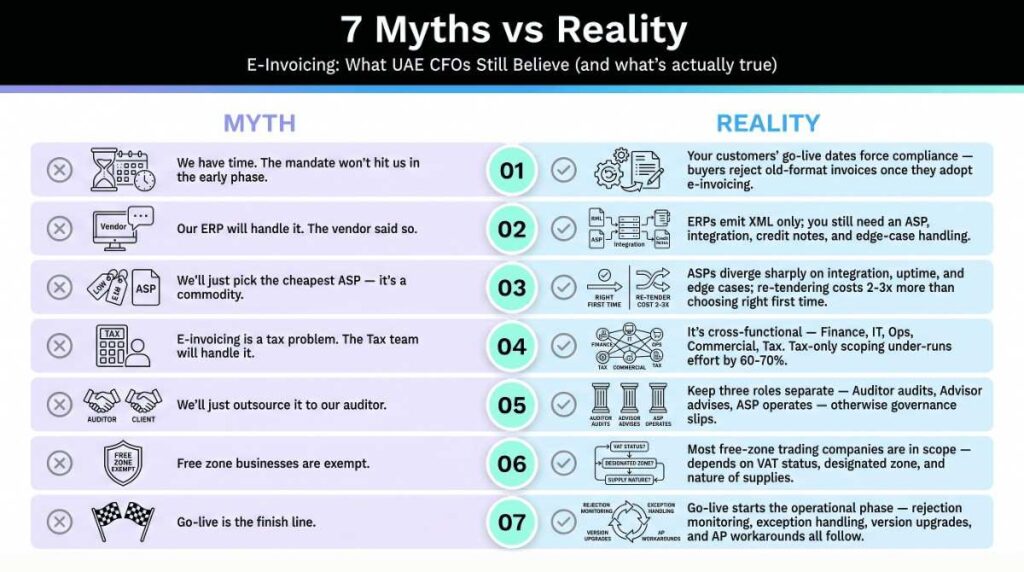
Myth 1: “We have time. The mandate won’t hit us in the early phase.”
You might. You might not. Revenue thresholds, sector, and registration status are shaping the phasing structure. Many businesses that assume “we’re too small” or “we’re a free zone, this doesn’t apply” will discover they’re in scope sooner than planned.
But here’s the bigger reason “we have time” is a trap: even if you’re in a later phase, your customers and suppliers won’t be. The day a major UAE buyer (think large retailer, large contractor, large free zone trader) goes live, every supplier they have suddenly has a problem: they’re sending invoices to a buyer who can no longer accept them in the old format. You’re forced into compliance not by the mandate, but by your customers.
What to do instead: Start a 60-minute readiness conversation now. Not a project. A conversation. You don’t need to spend anything yet.
Myth 2: “Our ERP will handle it. The vendor said so.”
Your ERP vendor said something true and incomplete. Most major ERPs (SAP, Oracle, Dynamics, Tally, Zoho) have or will have modules that produce e-invoicing-ready output. That part is real.
What’s incomplete is everything around the ERP. You still need an ASP to translate, sign, transmit, and report to the FTA. You still need the integration between your ERP and that ASP. You still need to handle credit notes, corrections, multi-entity routing, and edge cases.
The ERP is one corner of the 5-corner model. Crucial, but not sufficient.
What to do instead: Ask your ERP vendor specifically: “Will you handle PINT AE generation, FTA transmission, and audit trail or just XML output?” The honest answer will be “just XML output”. That’s your scoping gap.
Myth 3: “We’ll just pick the cheapest ASP, it’s a commodity.”
ASPs are not a commodity. They look similar in a sales deck. They diverge sharply in operational reality.
The differences that matter:
- integration depth with your specific ERPs,
- multi-entity handling,
- edge-case coverage (credit notes, RCM, free zone designated zone routing),
- uptime,
- audit trail retention,
- support speed,
and the boring-but-vital question of whether they’ll exist in three years.
Cheapest-ASP shoppers are usually the ones who re-tender in year two. Re-tendering is 2–3x more expensive than choosing right the first time.
What to do instead: The scoring framework filters out the cheap now and expensive later vendors in under 90 minutes.
Myth 4: “E-invoicing is a tax problem. The Tax team will handle it.”
E-invoicing is a tax problem, the way a building fire is a smoke problem. The smoke is real. It’s also not the thing you should be solving.
The actual work is:
- ERP integration (IT),
- invoice flow design (Operations),
- AP/AR process redesign (Finance),
- customer/supplier communication (Commercial),
- exception handling and training (Operations + Finance),
- audit-trail design (Compliance + Tax).
Tax owns one slice. Not even the biggest slice.
Companies that scope this as a tax project consistently underrun their effort estimates by 60–70%.
What to do instead: Form a four-person steering group: Finance, IT, Operations, Tax, one hour weekly. Tax is one chair; not the only one.
Myth 5: “We’ll just outsource it to our auditor.”
Your auditor is your auditor. Their job is to attest to your historical compliance, not to be your operational vendor and your reviewer of that same vendor.
There are an independence question and a capability question.
Some Big-4 firms have spun up advisory practices that will help you implement. That’s legitimate. But “we’ll just delegate this to our auditor” without separating those roles creates governance issues and usually costs more than going with a specialist advisory firm + a dedicated ASP.
What to do instead:
- Separate the roles cleanly. Auditor audits.
- Advisor (like KPI) advises. ASP (like Vantheon) operates.
Three roles, three vendors, three contracts. Sometimes two of them are the same firm. Fine. But the roles stay separate.
Myth 6: “Free zone businesses are exempt.”
Some are. Most aren’t. The exemption depends on VAT registration status, the nature of supplies, whether you operate in a designated zone or a non-designated free zone, and your customer base.
Many free zone trading companies, even ones that have historically been comfortable with simplified VAT treatment, will be in scope. The PINT AE specification has explicit handling for designated zone supplies. That tells you what you need to know about expected coverage.
What to do instead: Don’t self-assess on this. Have your tax advisor confirm in writing whether each entity in your structure is in scope and from which phase. This is a 30-minute conversation that protects you from a six-figure mistake.
Myth 7: ” Go-live is the finish line ”
Go-live is the start of the operational phase, not the end of the project. Post-go-live, the work is: monitoring rejection rates, investigating exceptions, refining master data, training new joiners, handling customer queries, managing version upgrades (PINT AE will evolve), and producing audit responses.
Companies that treat go-live as the finish line discover, around month 4, that their rejection rate is creeping up, no one owns the exceptions queue, and their AP team is quietly building workarounds.
What to do instead: Plan for a 90-day post-go-live war room. One full-time owner. Weekly scorecard. Then transition to BAU with a clear handover.
Don’t Let These Myths Delay Your UAE E-Invoicing Compliance. Partner With Vantheon Technologies Today
The UAE’s e-invoicing mandate is no longer a “future concern”; it’s a compliance reality that’s already reshaping how businesses invoice, report, and reconcile. Believing these myths any longer could cost your business penalties, delayed reconciliations, and lost audit readiness. At Vantheon Technologies, we help UAE CFOs and finance leaders separate facts from fiction with a proven E-Invoicing Solution built for full regulatory compliance and seamless ERP integration. Whether you need expert NetSuite Consulting Services to assess your current setup, seamless NetSuite ERP Integrations to connect your invoicing with your financial systems, reliable Oracle NetSuite Support Services for ongoing maintenance, a structured NetSuite ERP Implementation from the ground up, or tailored NetSuite Customization Services to fit your unique business workflows, our team of certified experts ensures your e-invoicing transition is smooth, compliant, and future-ready.
Don’t wait for a compliance deadline to catch you off guard. Schedule a Free Demo with our experts today and discover how Vantheon Technologies can simplify your e-invoicing journey in the UAE.