



UAE E-Invoicing for Businesses: The No-Panic Guide
It’s a Sunday evening. You’re scrolling through emails on your phone, half-watching a match, half-pretending tomorrow isn’t Monday.
Then you see it. Another forwarded article. Another LinkedIn post. Another panicky note from your auditor.
“E-invoicing. UAE. Phased rollout. ASP. Peppol. PINT AE. Compliance deadline.”
You close the email. You put the phone down. You tell yourself you’ll look into it next week.
You’ve been telling yourself that for the past six months.
If any of this feels familiar, then keep reading. This guide is built for exactly one person:
The busy finance leader who knows e-invoicing is coming suspects it’s bigger than it looks and quietly wishes someone would just explain the whole thing without the acronym soup.
We’ll do that here. No jargon you can’t follow. No vendor sales pitch. Just the picture, clearly, in the order it matters.
Here’s what we’ll cover:
- What is e-invoicing actually (and what it isn’t)?
- Why is the UAE is doing this now — and why is it not optional?
- The four words you need to understand: FTA, ASP, Peppol, PINT AE
- What changes for your business — invoicing, AP, AR, IT, your people?
- The honest timeline — what’s already happening, what’s next?
- The three biggest mistakes companies are about to make!
- What does ‘ready’ actually look like?
- What to do this week, this month, this quarter?
Grab a coffee. Give us fifteen minutes. By the end, you’ll know more about UAE e-invoicing than 90% of the people currently panicking about it.
Let’s start with the part everyone skips.
1. What E-Invoicing Actually Is (And What It Isn’t)
Most people hear ‘e-invoicing’ and picture a PDF. A nicely designed invoice. Emailed to a customer. Job done.
That’s not e-invoicing. That’s a digital invoice — which is what most of us have been sending for the last twenty years.
E-invoicing is something different. It’s a structured, machine-readable invoice that’s transmitted directly between two businesses (or a business and a government) through a regulated network. The invoice isn’t a document you read. It’s a file your software reads. And your country’s tax authority (Federal Tax Authority (FTA) in the case of the UAE) reads it too, often before your customer does.
Think of it this way:
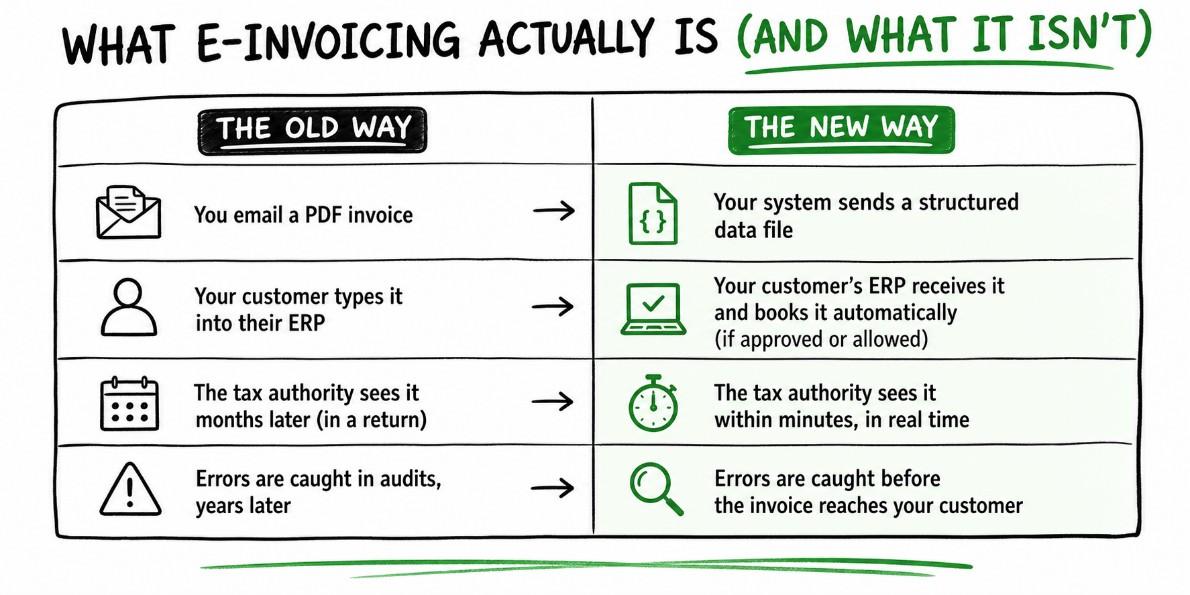
That’s the shift. Real-time. Structured. Validated. It’s not a software upgrade. It’s a different way of moving information between businesses and tax authorities
2. Why the UAE Is Doing This Now And Why It’s Not Optional
E-invoicing isn’t a UAE invention. It’s a global wave that started in Latin America in the early 2000s, swept across Europe in the 2010s, and arrived in the GCC in the 2020s.
Saudi Arabia launched its e-invoicing system (called Fatoora) in 2021. India rolled out its system for GST e-invoicing in 2020. Italy made it mandatory in 2019. Malaysia rolled out MyInvois in 2024. France, Belgium, Germany, Poland all are in flight.
The UAE is now joining the club.
Why now? Three reasons, in plain English:
- Tax compliance gets harder when invoicing is paper-based. Once Corporate Tax came in, the FTA needed better visibility into business transactions. E-invoicing gives them that. In near real time!
- Cross-border trade needs a common standard. A UAE company invoicing a Saudi customer, or a German supplier invoicing a Dubai distributor, can’t keep relying on PDFs and translations. E-invoicing done through a common, secure, global system – the Peppol network solves this.
- It’s quietly good for your business too. Once you get past the rollout pain, e-invoicing reduces errors, accelerates payments, eliminates manual data entry, and gives you cleaner audit trails. It pays back. But not just on day one.
Is it optional? No. The FTA has formally launched the framework; Accredited Service Providers (ASPs) are being approved, and phased rollout dates have been published. The only question is which phase your business falls into, not whether you’re affected.
If you issue tax invoices in the UAE, you’re in scope. Free zone, mainland, B2B, B2G, exports — there are nuances, but almost no escape hatches.
3. The Four Words You Need to Understand
Here are the only four acronyms that matter. We’ll explain each one in two sentences. No more.
The UAE’s tax regulator. Same body that runs VAT and Corporate Tax. They own the e-invoicing framework, accredit service providers, and receive the invoice data.
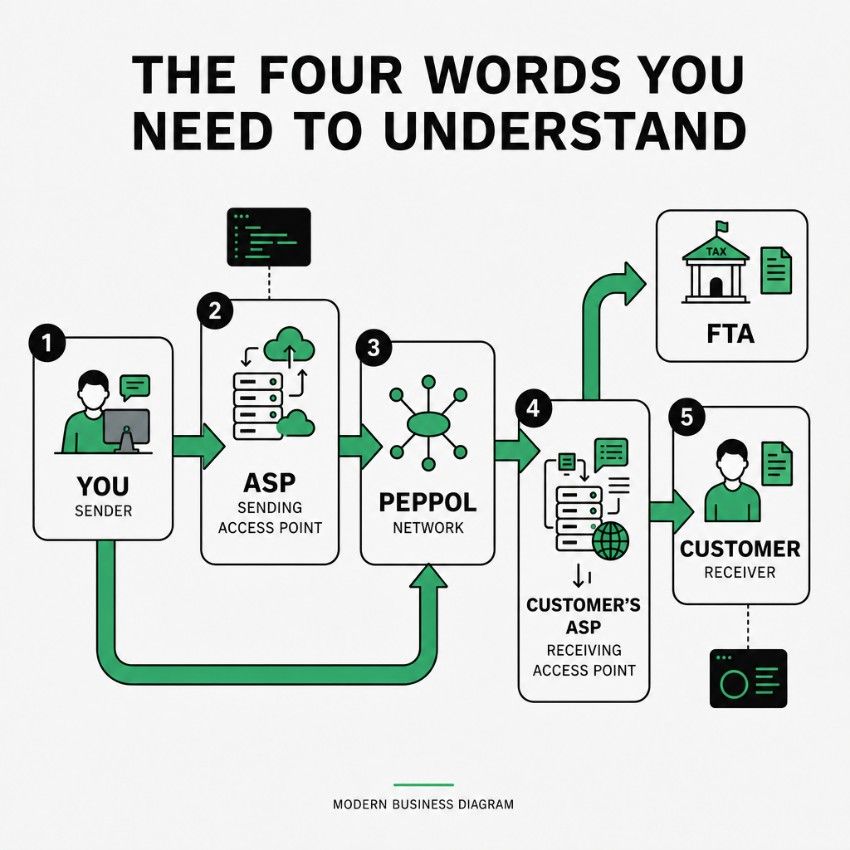
ASP – Accredited Service Provider
The middleman. The legitimate, FTA-approved middleman. An ASP sits between your business system (your ERP, accounting software, or POS) and the FTA. It takes your invoice, formats it correctly, signs it digitally, sends it to your customer, and reports it to the FTA.
Vantheon is one of the ASPs.
Peppol (pronounced ‘pep-ol’)
Think of it as the WhatsApp of business invoices — a global network that lets any business in any country send a structured invoice to any other business in any country, as long as both ends are connected. It’s not owned by any one company; it’s an international standard. The UAE has chosen Peppol as the backbone of its e-invoicing system.
PINT AE — Peppol International Invoice, UAE version
This is the file format your e-invoice has to be in. PINT is the global Peppol invoice standard; AE is the UAE-specific flavour. Your ASP handles this conversion. You don’t have to learn the format yourself.
That’s it. Four acronyms. If anyone tries to add more. politely interrupt them and ask why?
4. What Actually Changes for Your Business
Here’s the honest part: e-invoicing touches more of your business than people realise. Let’s walk through it, function by function.
For your AR team (Accounts Receivable)
This is the most visible change. Every invoice you issue must be:
- Created in a structured format (PINT AE)
- Digitally signed
- Transmitted through your ASP
- Validated by the FTA (in seconds or minutes)
- Delivered to your customer’s network endpoint (ASP)
- Archived in tamper-proof form
E-invoicing automates invoice delivery, rendering manual PDF sending obsolete. Consequently, your AR team’s daily focus shifts from manual execution to exception management, specifically addressing system rejections and customer disputes.
For your AP team (Accounts Payable)
This is the part most companies forget. Our AP team will stop typing invoices into the ERP. Instead, our ERP will automatically receive and book structured invoice data, changing your AP team’s role from data entry to data review.
That sounds great. It mostly is. But it requires:
- A clean supplier masters
- Clear coding rules (which GL account, which cost centre)
- An exception-handling process for invoices that don’t auto-match
- Training, because the AP role changes meaningfully
Most rollout pain we’ve seen ( in KSA, India, & Malaysia) happened on the AP side, not the AR side.
For your IT team
They need to know:
- Which ERPs and systems issue invoices?
- How will those systems connect to the ASP (API, file drop, plug-in)?
- What master data needs cleaning (especially tax codes, customer profiles, item codes)?
- How will exception handling flow back into the ERP?
A good ASP makes IT’s life easier. A bad one turns this into a six-month integration project.
For your finance leadership
You become responsible for compliance. And for the audit trail.
The good news: real-time validation means fewer surprises at year-end.
The hard news: penalties for late or incorrect e-invoicing are typically harsher than for paper-era mistakes. The FTA can see things in real time, and that cuts both ways.
For your operations and sales teams
Less visible but still real. Quoting, order management, contract billing, milestone invoicing — every workflow that ends in ‘issue invoice’ needs to land cleanly in the e-invoicing system. If your sales team books deals with unusual billing structures (annual prepayments, progress billing, multi-currency), you need to map them now.
5. Timeline: What’s Already Happening, What’s Next
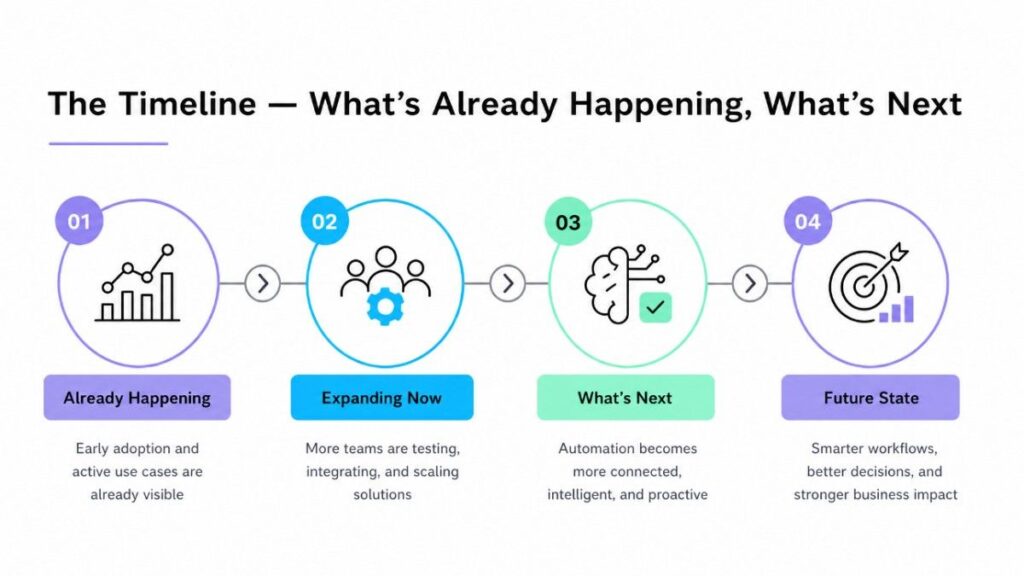
The UAE is introducing e-invoicing in stages. Here’s where things actually stand:
Phase 1: Framework and accreditation (now)
The FTA has published the framework. ASPs (like Vantheon) are being formally accredited. The first wave of approved providers is being finalized; the initial cohort is expected to include around 50 ASPs, with the total possibly reaching ~150 over time.
Phase 2: Pilot and early adoption (next 6–12 months)
A subset of large businesses will go live first—typically those with the highest invoice volumes and the strongest technical readiness. This serves as the initial system stabilization phase.
Phase 3: Mandatory rollout by segment
Phased mandates by business size, sector, or transaction type. Larger businesses first, then smaller businesses. Each wave gets a set go-live date.
Phase 4: Full coverage
All in-scope organizations must operate fully under the mandatory e-invoicing regime. The Ministry of Finance and the Federal Tax Authority (FTA) have set an aggressive timeline based on annual turnover, phased in as follows:
- Large Businesses (≥ AED 50M revenue): Must formally appoint an Accredited Service Provider (ASP) by October 30, 2026, with a mandatory go-live date of January 1, 2027.
- SMEs (< AED 50M revenue): Must appoint their ASP by March 31, 2027, and go live by July 1, 2027.
- Government Entities: Must appoint an ASP by March 31, 2027, and begin mandatory compliance on October 1, 2027.
6. The Three Biggest Mistakes Companies Are About to Make
We’ve watched this movie in four other countries. The script is depressingly consistent.
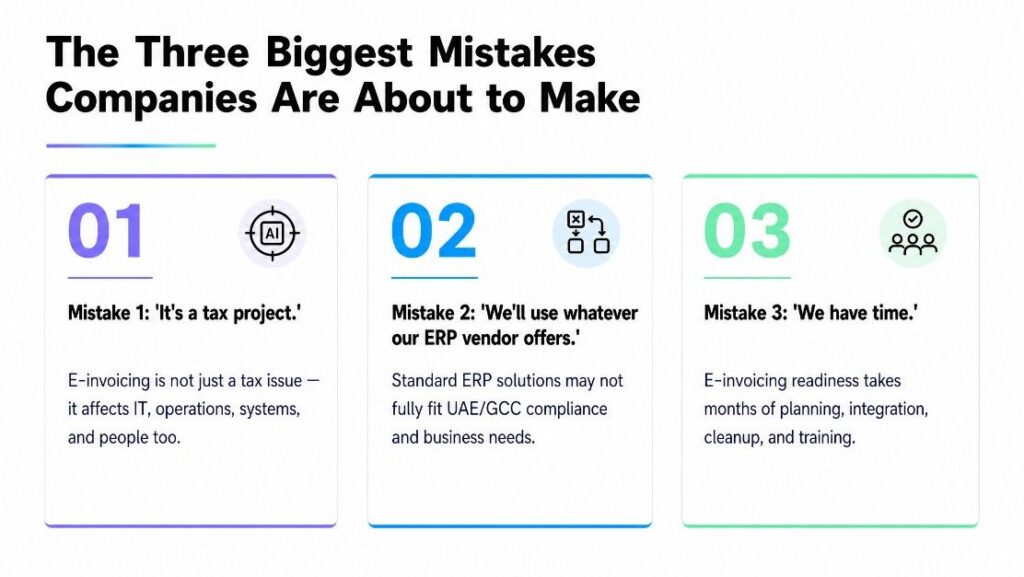
Mistake 1: ‘It’s a tax project.’
Someone, usually the auditor, flags e-invoicing. It lands on the Tax Manager’s desk. The Tax Manager dutifully reads the framework, writes a memo, and files it. Three months later, the memo is the only output.
E-invoicing isn’t a tax project. It’s a tax-led, IT-executed, operations-impacting, people-dependent transformation. If the only person who’s reading the FTA guidelines is your Tax Manager, you’re already behind.
Mistake 2: We’ll use whatever our ERP vendor offers.
Your ERP vendor will tell you they have an ‘e-invoicing module. Great. You think you can just turn it on.
But the vendor module is built for a global average. Global software plug-ins do not recognize regional nuances like UAE free zones, GCC cross-border sales, or complex billing cycles. They require heavy configuration and still fail to link directly to the FTA.
A dedicated, FTA-accredited ASP bypasses this customization delay entirely with built-in UAE compliance and network connectivity.
Mistake 3: ‘We have time.’
You don’t.
Even if your specific go-live date is 12 months away, the path to ‘ready’ is at least 4–6 months for most businesses. Process mapping, ASP selection, ERP integration, master data cleanup, AP/AR redesign, training, parallel running, exception handling — none of this is one weekend’s work.
Companies that start in Q1 finish comfortably by Q3. Companies that start in Q3, scramble through Q4, and live with chaos through their first filing cycle.
7. What ‘Ready’ Actually Looks Like
A lot of articles will give you a checklist. We’ll give you a picture.
You’re ready when:
- Every invoice your business issues can be generated in PINT AE format, signed, sent, and tracked automatically, with no manual intervention required
- Every invoice your suppliers send arrives as structured data, gets validated, gets coded, and lands in your ledger with minimal touching
- Your AR and AP teams know what to do when an invoice is rejected before the customer or supplier calls
- Your IT team has documented connections from every invoicing system to your ASP and tested fallback procedures for outages
- Your tax team can pull, at any moment, a complete audit trail of every invoice issued and received, in real time
- Your finance leadership receives a weekly e-invoicing health report, clearly showing:
- volume processed,
- rejections,
- exceptions,
- time-to-payment trends
- Your sales and operations teams know which invoice scenarios are ‘standard’ and which need pre-approval before they’re booked
- You’ve run at least one full cycle in parallel paper plus e-invoicing so you know what really happens, not what the slides say
This defines operational readiness. If any item on this list exposes a gap in your planning, that is exactly where your project needs to begin.
8. What to Do This Week, This Month, This Quarter
Specific, actionable, in order:
This week (60 minutes of work, total)
- Forward this guide to your CFO, IT head, and tax lead. Tell them to read it before your next finance meeting.
- Put a recurring 30-minute slot in everyone’s calendar — same time every Tuesday — to discuss e-invoicing. Even if you have nothing to discuss yet.
- Open a shared folder. Drop the FTA’s official e-invoicing framework documents in it. Drop this guide in it. You’ve started.
This month
1.Run a scoping exercise. What invoice types do you issue?
- Standard sales,
- intercompany,
- exports,
- RCM,
- advances,
- credit notes & debit notes
- Who issues them, in which system, in what volume?
- Map your supplier landscape. How many AP invoices come in monthly? From how many vendors? In how many formats?
- Have an exploratory conversation with at least two ASPs. Not a sales pitch. A diagnostic. Ask them: ‘Given my setup, what would the path look like?’ You’re not buying yet. You’re learning.
This quarter
- Pick your ASP and ask Questions to Ask Before You Pick an ASP
- Form a small steering group. Finance, IT, Tax, Operations. One hour every Tuesday. Real decisions, real owners.
- Begin the integration pilot. Start with one invoice type, in one system, in one entity. Get it working end-to-end before you scale.
- Start training your AP team. They’re the dark-horse risk. Get them ready early.
The One-Line Summary You Can Tell Your Board
‘UAE e-invoicing is not a software upgrade. It’s a real-time, structured, government-validated way of issuing and receiving invoices. We have a 4–6 months path to readiness; we’re starting with an ASP-led integration, and the AP team is our biggest risk. Not the technology!’
If you can say that, confidently, you’re already ahead of most UAE businesses.
One Honest Closing Thought
The UAE has watched four other countries roll out e-invoicing. We’ve all seen what works and what doesn’t. The good news for UAE businesses: you don’t have to make the mistakes that hurt companies in KSA, India, Italy, and Malaysia. The framework here has learned from theirs.
You just need to start.
Not next quarter. Not after the budget cycle. Not when your specific deadline is announced.
This Tuesday. Thirty minutes. Three people. One shared folder.
That’s the whole secret.
Get Your Business E-Invoicing Ready With Expert Support
Getting your business ready for UAE E-Invoicing doesn’t have to be a solo effort. At Vantheon Technologies, our team helps companies across the UAE implement compliant, future-ready invoicing systems without the technical headaches. Whether you need seamless ERP and accounting software integration, a tailored Oracle NetSuite Customization Services, or end-to-end Oracle NetSuite Consulting Services to future-proof your operations, our specialists are here to guide you every step of the way. Don’t wait until the compliance deadline creeps up — Contact Us Today and let Vantheon Technologies handle the complexity while you focus on growing your business.
FAQ:
1. Is UAE e-invoicing optional?
No. The FTA has launched the framework and accredited service providers are being approved. Phased mandates apply by business size and segment. If you issue tax invoices in the UAE, you are in scope.
2. What is an ASP in UAE e-invoicing?
An ASP, or Accredited Service Provider, is the FTA-approved middleman that sits between your business systems and the tax authority. It formats, signs, transmits, validates, and archives your e-invoices. Vantheon is one such ASP.
3. What is PINT AE?
PINT AE is the UAE-specific version of the Peppol International Invoice format. It is the structured XML file format your e-invoices must be in.
4. How long does it take to be e-invoicing ready in the UAE?
For most businesses, 4 to 6 months covers scoping, ASP selection, ERP integration, master data cleanup, AP/AR redesign, training, and parallel running.
5. What is the biggest mistake businesses make with e-invoicing?
Treating it as a tax project. E-invoicing touches IT, finance operations, AP and AR teams, and customer-facing processes.