




If your business operates in both the UAE and Saudi Arabia, treating e-invoicing as one regional requirement is the first mistake to avoid. The two countries run on genuinely different frameworks, different regulators, and different implementation timelines. Saudi Arabia already has an established clearance-based system in active rollout. The UAE is moving to a decentralized, Peppol-based model that only became mandatory for early adopters in 2026, with wider mandatory dates through 2027.
This guide breaks down exactly where UAE and KSA e-invoicing diverge, where they overlap, and how businesses operating across both markets should architect their ERP systems so a single centralized platform can still handle two very different compliance frameworks correctly.
What Is E-Invoicing and Why Does It Matter in the GCC?
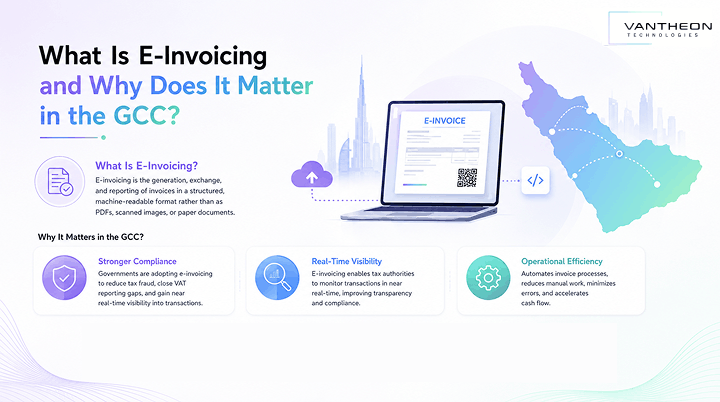
E-invoicing is the generation, exchange, and reporting of invoices in a structured, machine-readable format rather than as PDFs, scanned images, or paper documents. Across the GCC, governments are adopting e-invoicing to reduce tax fraud, close VAT reporting gaps, and gain near real-time visibility into business transactions.
For companies operating regionally, GCC e-invoicing regulations matter because they are not converging into a single standard. Saudi Arabia and the UAE have each built their own frameworks, with their own regulators, formats, and integration models. A business running one ERP instance across both countries needs that system to understand both sets of rules at once, not just one generic version of e-invoicing.
UAE vs KSA E-Invoicing: What Are the Key Differences?
1. Regulatory Authority
In the UAE, the Ministry of Finance is responsible for the federal Electronic Invoicing System, and it is the body that accredits the service providers businesses must use to connect. In Saudi Arabia, the Zakat, Tax and Customs Authority, known as ZATCA, oversees the Fatoora e-invoicing framework directly, including invoice clearance and reporting.
This distinction matters operationally. In the UAE, businesses do not connect directly to a government portal; they connect through an Accredited Service Provider approved by the Ministry of Finance. In Saudi Arabia, invoices are submitted through an integration that ultimately routes to ZATCA’s own Fatoora platform.
2. E-Invoicing Framework
The UAE system is based on OpenPeppol, which the Ministry of Finance describes as an internationally recognized framework for electronic document exchange and interoperability. Invoices are exchanged as structured data in the PINT AE format, the UAE’s own Peppol International Invoice specification, built on the UBL standard with UAE-specific extensions.
Saudi Arabia uses the ZATCA Fatoora framework, which has its own technical and business requirements separate from Peppol entirely. ZATCA maintains an extensive educational library covering detailed e-invoicing guidelines, technical requirements, security requirements, invoice specifications, and developer resources, all specific to the Saudi market.
These are not two flavors of the same system. They are architecturally different frameworks, and an ERP configuration built for one will not simply carry over to the other.
3. Implementation Timeline
Saudi Arabia’s e-invoicing mandate is already well underway. Phase 1 (Generation) began December 2021. Phase 2 (Integration) started January 1, 2023, and has rolled out in waves since, pulling in smaller businesses as ZATCA lowers the revenue threshold each wave.
The UAE, by comparison, is earlier in its rollout, and now has separate appointment and go-live dates. A voluntary pilot opened July 1, 2026. Large businesses (AED 50 million or more in revenue) must appoint an Accredited Service Provider by 30 October 2026 and go live from January 1, 2027. Smaller businesses must appoint an ASP by 30 March 2027 and go live from 1 July 2027, with government entities following from 1 October 2027. The UAE’s mandate is still in its early implementation window, so businesses have a narrower runway than they might assume, and deadlines have already shifted once since the framework was announced.
4. Integration Model
The UAE’s integration model is built around Accredited Service Providers, or ASPs, operating within the Peppol network. A business does not connect directly to the Federal Tax Authority. Instead, its ERP or accounting system connects to its chosen ASP, which validates and routes structured invoices through Peppol Access Points to the recipient’s own ASP, while relevant tax data is reported to the Federal Tax Authority for monitoring. This is often described as a five-corner model: the supplier, the supplier’s ASP, the buyer’s ASP, the buyer, and the tax authority. The UAE Ministry of Finance specifically states that its system is based on OpenPeppol and designed to support interoperability and cross-border trade, which is part of why the country chose this decentralized architecture over a centralized government portal.
Saudi Arabia’s integration model works differently. Businesses connect to an E-Invoice Generation Solution, either built into their ERP or layered alongside it, directly to ZATCA’s Fatoora platform through an API. Depending on the invoice type, that connection either clears the invoice before it reaches the buyer or reports it to ZATCA shortly after issuance. ZATCA’s detailed guidance states that Phase 2 tax invoices are submitted in XML to the Fatoora platform for clearance using APIs, which is a fundamentally more centralized model than the UAE’s distributed ASP network.
5. Invoice Format and Data Requirements
In the UAE, the focus is on structured electronic invoices exchanged in the PINT AE format, built for Peppol-based interoperability. The emphasis is on standardized data fields that allow invoices to move seamlessly between different ASPs and different businesses, both domestically and, eventually, across borders that also use Peppol.
Saudi Arabia’s requirements are more layered and depend on the specific invoice type and applicable rules, so it is worth being precise here rather than treating every Saudi e-invoice as identical. ZATCA’s detailed guidance specifies XML, or PDF/A-3 with embedded XML, for certain Phase 2 invoice presentation requirements, while XML is submitted to Fatoora for applicable clearance processes. Required fields include a unique invoice identifier, a QR code for verification, and a cryptographic stamp applied through ZATCA-approved solutions. Standard tax invoices go through clearance before reaching the buyer, while simplified invoices, typically used in business to consumer transactions, are reported to ZATCA within a set window after issuance rather than cleared beforehand. In short, the correct Saudi format and process depend on the invoice type, not a single universal rule.
6. Clearance vs Exchange and Reporting
This is the single most important conceptual difference between the two markets, and one that is easy to blur if you are not careful.
In Saudi Arabia, for applicable Phase 2 tax invoices, ZATCA’s process involves submitting the XML invoice to Fatoora for clearance before the cleared invoice is sent to the buyer. ZATCA’s simplified guide describes this process explicitly: the invoice does not reach the customer until it has been validated and cleared by the tax authority. This is a genuine pre-clearance model.
The UAE model works differently. It is built around structured electronic invoice exchange through the Peppol network and Accredited Service Providers, with the Federal Tax Authority receiving reporting data for monitoring and compliance purposes rather than clearing each invoice before it reaches the buyer. Invoices flow between trading partners through their respective ASPs, and the tax authority’s visibility comes through the reporting layer of that exchange, not through a pre-approval step.
It is worth being direct about this: the UAE’s Peppol-based exchange model and Saudi Arabia’s clearance model are not the same architecture wearing different names. One is a decentralized reporting network; the other is a centralized approval gateway. Businesses that assume e-invoicing is e-invoicing across both countries risk building an integration that technically works in one market and fails compliance in the other.
UAE vs KSA E-Invoicing: Key Similarities
Despite their architectural differences, the two frameworks share common ground. Both mandates require invoices to exist as structured, machine-readable data rather than PDFs, scans, or paper. Both are being rolled out in phases rather than all at once, giving businesses a defined runway to prepare rather than an overnight switch. Both require businesses to issue invoices through compliant e-invoicing software, though the two diverge here: KSA has no mandatory intermediary, since taxpayers connect their software directly to ZATCA’s Fatoora platform, while the UAE requires every business to transmit invoices through a government-accredited Service Provider. And both frameworks ultimately serve the same objective: closing the VAT reporting gap and gaining real-time visibility into business transactions.
How UAE and Saudi E-Invoicing Affect ERP Systems
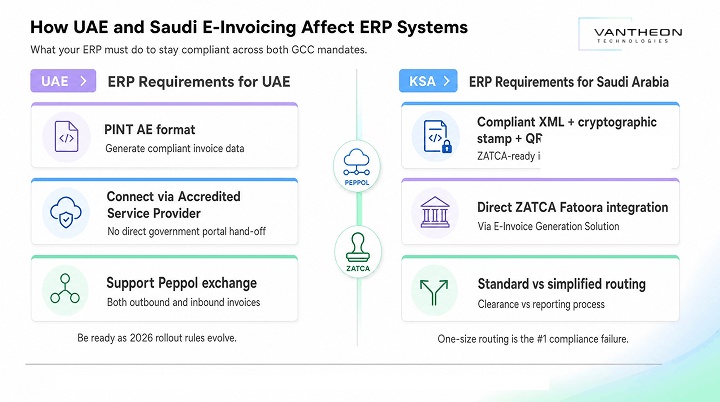
ERP Requirements for UAE
To meet UAE requirements, an ERP needs to generate invoices in the PINT AE format, connect to an Accredited Service Provider rather than a government portal directly, and support the Peppol exchange model for both outbound and inbound invoices. Because the UAE mandate is still in its early phase, businesses also need an ERP that can adapt as ASP accreditation rules and implementation dates continue to be clarified by the Ministry of Finance.
ERP Requirements for Saudi Arabia
To meet Saudi requirements, an ERP needs to generate compliant XML invoices, apply the required cryptographic stamp and QR code, and connect directly to ZATCA’s Fatoora platform through an E-Invoice Generation Solution. It also needs to correctly route standard invoices through the clearance process and simplified invoices through the reporting process, since treating every invoice the same way is one of the most common sources of compliance failure in Saudi Arabia.
Can One ERP Support E-Invoicing in Both UAE and KSA?
Yes, a multi-country ERP can support e-invoicing across both the UAE and KSA, but businesses should not assume that the same country’s configuration, integration, or workflow can simply be copied between the two markets.
The right architecture is a single centralized ERP platform with country-specific localization layered on top of it; not two separate systems bolted together. In practice, that means one ERP instance handling group-level financial reporting and data, with the UAE’s Peppol and ASP architecture configured for UAE entities and Saudi Arabia’s ZATCA and Fatoora architecture configured separately for KSA entities. Customers, vendors, tax classifications, and chart of accounts stay standardized at the group level, while the actual e-invoicing integration, invoice format, and compliance workflow are configured per country according to that country’s specific rules. This gives finance teams centralized reporting and group-level visibility while still meeting each country’s requirements on its own terms. For companies genuinely operating across both markets, this is the model worth building toward, rather than a patchwork of disconnected local systems.
Multi-Country Tax Invoicing: What Businesses Need to Configure
Multi-country tax invoicing across the UAE and KSA requires several layers of configuration working together correctly. Tax codes and VAT rates need to be set up separately for each country, since UAE VAT and Saudi VAT are governed independently. Invoice numbering and sequencing need to follow each country’s specific rules. Master data, including customer VAT registration numbers, legal entity details, and addresses, needs to be accurate and complete for both jurisdictions, since incomplete data is one of the most common causes of invoice rejection in either market. Integration endpoints need to be configured separately, since UAE invoices route through an Accredited Service Provider while Saudi invoices route through ZATCA’s Fatoora API. And exception handling needs to account for the different failure modes each system produces, since a rejected clearance in Saudi Arabia behaves differently than a failed exchange through an ASP in the UAE.
Cross-Border Compliance ERP for GCC Businesses
For businesses expanding further across the GCC, the same architectural principle applies beyond just the UAE and KSA. A cross-border compliance ERP for GCC operations should be built around one centralized platform, standardized group-level data, and country-specific compliance modules for each market a business operates in, since other GCC countries are developing their own e-invoicing frameworks on their own timelines. Designing the ERP this way from the start avoids having to re-architect the system every time a new country mandate goes live.
How NetSuite Can Support UAE and KSA E-Invoicing
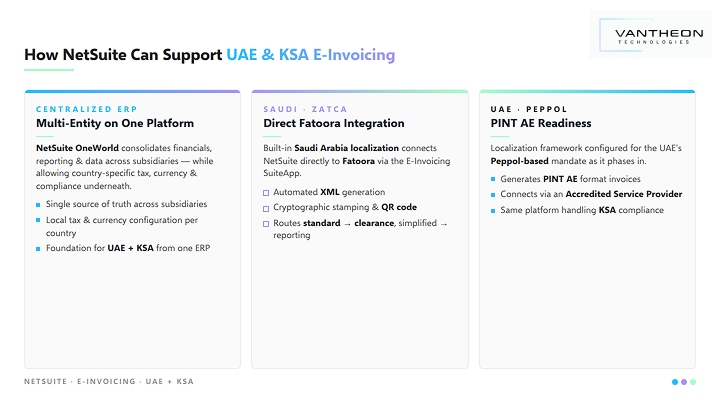
Centralized Multi-Entity ERP
NetSuite OneWorld gives multi-country businesses a single platform for financial consolidation, reporting, and data management across subsidiaries, while still allowing country-specific tax, currency, and compliance configuration underneath that centralized structure. This is the foundation that makes supporting both UAE and Saudi e-invoicing requirements from one system realistic rather than theoretical.
Saudi-Specific E-Invoicing
NetSuite supports Saudi VAT and ZATCA e-invoicing requirements through dedicated localization tools, including a Saudi Arabia E-Invoicing SuiteApp that connects NetSuite directly to the Fatoora platform, handling XML generation, cryptographic stamping, and the clearance or reporting workflow depending on invoice type.
UAE E-Invoicing Readiness
As the UAE’s Peppol-based mandate moves through its phased rollout, NetSuite’s localization framework can be configured to generate PINT AE format invoices and connect to an Accredited Service Provider, positioning businesses to meet UAE requirements on the same platform already handling their Saudi compliance, rather than requiring a separate system for each country.
UAE vs KSA E-Invoicing Implementation Checklist
Confirm which entities and transaction types fall within scope in each country, and by which deadline. Identify and appoint the required third party for each market, an Accredited Service Provider in the UAE and a ZATCA-compliant e-invoicing solution in Saudi Arabia. Validate that master data, including VAT registration numbers, legal entity information, and addresses, is accurate for both jurisdictions. Confirm your ERP can generate the correct invoice format for each country, PINT AE for the UAE and XML or PDF/A-3 with embedded XML for Saudi Arabia depending on invoice type. Test the full integration path in both markets before go-live, including how each system behaves when an invoice fails validation. Build a monitoring process for regulatory updates in both countries, since both frameworks are still evolving.
Common Challenges for Businesses Operating in Both UAE and KSA
Treating Both Markets as Having the Same Rules
The most common and most costly assumption is that a compliance approach built for one country will simply work on the other. Given how differently the clearance and exchange models operate, this assumption alone can cause invoices to fail in production.
Using a Single Invoice Template
A single generic invoice template rarely satisfies both the UAE’s PINT AE structure and Saudi Arabia’s XML and QR code requirements at the same time. Each country needs its own template of logic built into the ERP, not a shared template with minor tweaks.
Poor Master Data
Incorrect VAT numbers, legal entity information, tax classifications, customer addresses, or product tax codes can create downstream compliance issues in either country, or these issues tend to surface at the worst possible time, during invoice validation rather than during setup.
Duplicate Systems
Multiple disconnected invoicing systems, one for each country, can create data duplication, reconciliation problems, reporting inconsistencies, and higher maintenance costs. This is precisely the outcome of a centralised ERP with country-specific localization is designed to avoid.
Lack of ERP Localization
A global ERP without proper country-specific configuration can create compliance gaps that are not obvious until an invoice is rejected, or a regulator asks a question. Localization is not optional for detail work; it is the difference between a compliant system and a liability.
Manual Reconciliation
Relying on manual checks to confirm that invoices cleared in Saudi Arabia or exchanged successfully in the UAE does not scale as transaction volume grows. Automated status tracking and exception management matter because they catch failed clearances, rejected exchanges, and missing tax data immediately, rather than weeks later during a VAT filing or an audit.
How to Build a GCC-Ready E-Invoicing ERP Strategy
- Map every country’s requirement. Don’t start with technology. Start with the chain from regulation to invoice to tax data integration, so you understand what each country actually requires before you configure anything.
- Build a common ERP data model. Standardize customers, vendors, products, tax classifications, entities, and the chart of accounts at the group level, so every country configuration is built on the same underlying data structure.
- Add country-specific compliance layers. For the UAE, this means Peppol, an Accredited Service Provider, and UAE-specific rules. For Saudi Arabia, this means ZATCA, Fatoora, and Saudi-specific rules. These layers sit on top of the common data model rather than replacing it.
- Automate exception management. Monitor rejected invoices, failed API calls, invalid data, missing tax information, and integration errors as they happen, so issues are caught and resolved before they compound.
- Monitor regulatory changes. E-invoicing frameworks continue to evolve in both countries, and deadlines have already shifted in the UAE’s rollout since it was first announced. This is especially important for a regional GCC ERP strategy, since a static configuration will eventually fall out of step with a moving requirement.
UAE vs KSA E-Invoicing: Which Is More Complex?
Neither framework should be labeled universally more complex. The real answer depends on the business model, transaction types, ERP architecture, and implementation requirements involved. Saudi Arabia currently has an established Phase 2 integration and clearance or reporting framework that has been live and evolving since 2023, which gives businesses there a clearer, more mature set of expectations to build against. UAE businesses, meanwhile, are preparing for a Peppol-based federal system with phased implementation beginning in 2026 and mandatory implementation dates beginning in 2027, which brings its own complexity in the form of a newer framework, ASP selection, and rules that are still being clarified. A business with simple, domestic B2B invoicing may find one market straightforward and the other more involved, while a business with complex multi-entity operations may find the reverse. The honest answer is that complexity is specific to your business, not a fixed property of either country.
Why Businesses Need a Regional ERP Partner
Configuring one ERP correctly for two different e-invoicing frameworks, each with its own regulator, format, and integration model, is not a project most internal finance or IT teams take on regularly. A partner with direct, current experience in both UAE Peppol and Saudi ZATCA implementations understands the practical failure points before they happen, from ASP accreditation timing to Fatoora clearance rejections, and can build a single ERP architecture that holds up under both frameworks rather than treating them as an afterthought bolted onto each other.
Why Choose Vantheon Technologies?
Vantheon Technologies helps businesses across the UAE, Saudi Arabia, and the wider GCC build NetSuite environments that handle multi-country compliance correctly from a single platform. Our team brings direct implementation experience in both UAE and KSA markets, covering NetSuite OneWorld for centralized multi-entity ERP, country-specific e-invoicing integration, tax workflow configuration, and the data migration work needed to move a business onto one properly localized system. We also provide ongoing support and optimization as UAE and Saudi requirements continue to evolve, so your ERP architecture stays compliant rather than requiring a rebuild every time a regulation changes.
Conclusion
UAE and KSA e-invoicing are not two versions of the same requirement. Saudi Arabia runs a centralized clearance model through ZATCA and Fatoora that has been in active rollout since 2023, while the UAE is building a decentralized, Peppol-based exchange model through Accredited Service Providers that only began its phased mandatory rollout in 2026 and 2027. Businesses operating across both markets get the best outcome from one centralized ERP platform with country-specific compliance layers built on top of it, rather than assuming a single workflow, template, or integration will work identically in both places. Getting that architecture right from the start is what allows a business to scale across the GCC without rebuilding its compliance setup every time it enters a new market.
Operating across the UAE, KSA, or the wider GCC and want your NetSuite environment built to handle both e-invoicing frameworks correctly? Schedule a demo with Vantheon Technologies to assess your current setup and map out a compliant, centralized ERP architecture for both markets.
Beyond UAE and KSA e-invoicing, Vantheon supports the full scope of your NetSuite environment. Our NetSuite implementation services help businesses stand up a properly localized system from day one, while our NetSuite consulting services help you plan a multi-country roadmap before you commit to an architecture. For businesses already live on NetSuite, our NetSuite integration services connect your ERP to the banking, logistics, and third-party systems your operations depend on across the region. We also provide NetSuite OneWorld implementation for centralized multi-entity reporting, NetSuite customization services for workflows that need it, and dependable NetSuite support and maintenance to keep your compliance configuration current as UAE and Saudi requirements continue to evolve. Whether you need Saudi Arabia NetSuite services, UAE NetSuite services, or a broader multi-country ERP solution built to scale across the GCC, our team can help you get there on one platform.
Schedule a demo with Vantheon Technologies to start building a compliant UAE and KSA e-invoicing architecture on one NetSuite platform.
Frequently Asked Questions
1. What is the difference between UAE and Saudi Arabia e-invoicing?
The UAE uses a decentralized, Peppol-based exchange model where invoices move between trading partners through Accredited Service Providers, with the Federal Tax Authority receiving reporting data for monitoring. Saudi Arabia uses a centralized clearance model through ZATCA’s Fatoora platform, where applicable invoices are validated and cleared by the tax authority before reaching the buyer.
2. Is e-invoicing mandatory in both UAE and KSA?
Yes, though on different timelines. Saudi Arabia’s e-invoicing mandate has been in phased rollout since 2021, with Phase 2 integration active since 2023. The UAE’s mandate began a voluntary pilot in July 2026, with mandatory implementation starting January 2027 for large businesses and extending through 2027 for smaller businesses and government entities.
3. Can one ERP handle UAE and Saudi e-invoicing?
Yes. A single centralized ERP platform, such as NetSuite OneWorld, can handle both frameworks by combining standardized group-level data with country-specific compliance layers, UAE Peppol and ASP integration on one side and Saudi ZATCA and Fatoora integration on the other, rather than using one identical configuration for both countries.
4. What is the role of Peppol in UAE e-invoicing?
Peppol is the international framework the UAE has adopted as the backbone of its Electronic Invoicing System. Invoices are exchanged in the PINT AE format between Accredited Service Providers under a decentralized model, allowing structured, interoperable invoice exchange between trading partners while the Federal Tax Authority receives reporting data for compliance monitoring.
5. What is the role of Fatoora in Saudi e-invoicing?
Fatoora is ZATCA’s e-invoicing platform, and it sits at the center of Saudi Arabia’s compliance model. Businesses submit applicable tax invoices to Fatoora in XML format for clearance before they reach the buyer, while simplified invoices are reported to Fatoora shortly after issuance rather than cleared in advance.
6. How should businesses operating in UAE and KSA manage e-invoicing compliance?
Businesses should build one centralized ERP data model for customers, vendors, tax classifications, and entities, then layer country-specific compliance configuration on top for each market, rather than running separate disconnected systems or assuming one workflow applies to both. Working with a partner experienced in both frameworks helps avoid integration and master data issues that most commonly cause invoice failures in either country.